

Her Majesty Queen Sirikit, The Queen Mother, is often remembered for intimate moments of public health work. A patient examined during a royal visit. A transfer arranged when local care fell short. Follow-ups that continued long after the visit ended.
Through the Thai Red Cross Society, that way of thinking became institutional. When Thailand later faced humanitarian emergencies and public health crises, the structures needed to respond were already in place.
Humanitarian Relief When It Mattered Most
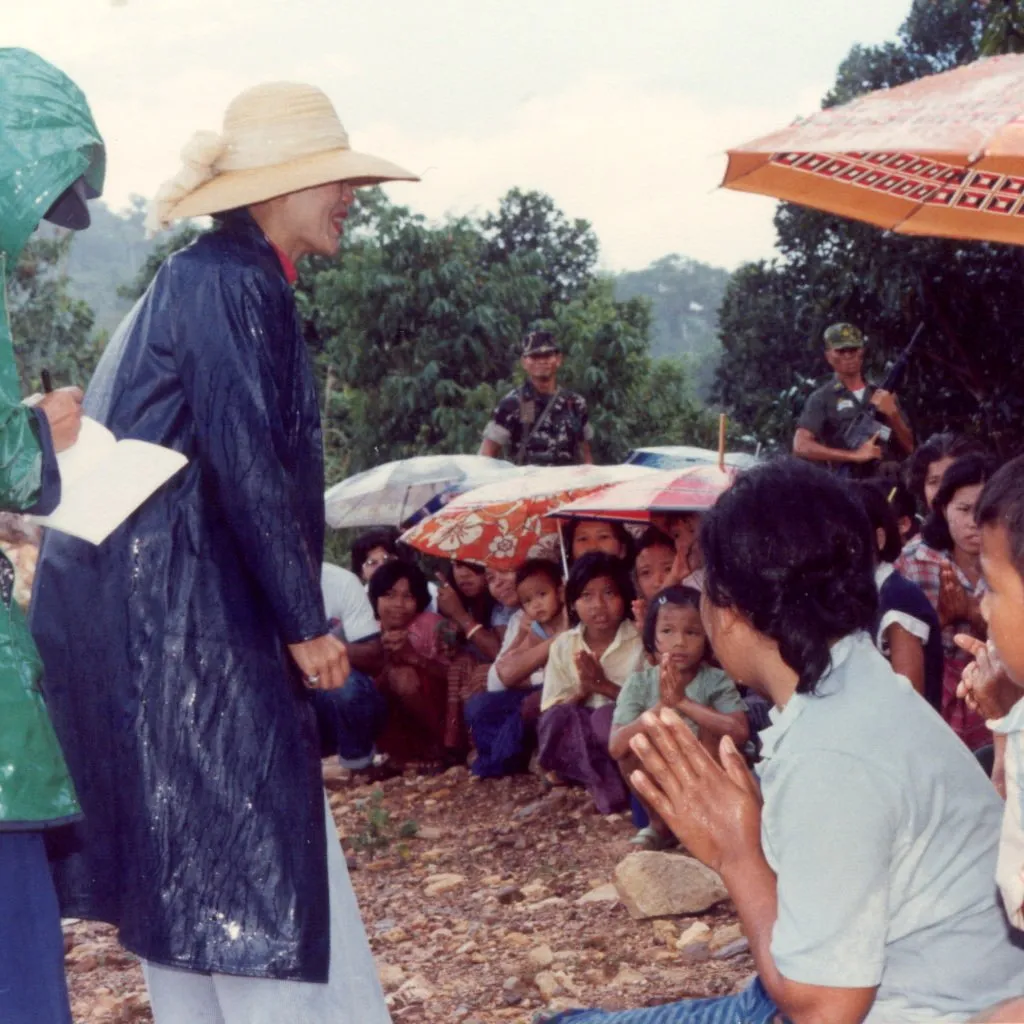
As Queen Sirikit’s health interventions expanded, they moved beyond individual cases and into national systems. The most important of these was her long-standing role as President of the Thai Red Cross Society, where healthcare widened into humanitarian response, disaster relief, and long-term social care.
One of the clearest examples came in May 1979, during the Cambodian refugee crisis along Thailand’s eastern border. Tens of thousands of refugees crossed into Trat, many of them injured, malnourished, or separated from family. The response required more than emergency medicine. It required logistics, coordination, and sustained care.
Under the Queen’s patronage, the Thai Red Cross established the Khao Lan Thai Red Cross Centre, which provided medical treatment, food, shelter, education for children, and vocational training for adults.
As the crisis eased, the centre evolved rather than closed. It became the Rajakarun Centre, shifting its focus to long-term humanitarian training, disaster preparedness, and regional cooperation. The lesson carried forward was simple: that public health does not stop at hospitals.
Building Capacity Beyond Emergency Response
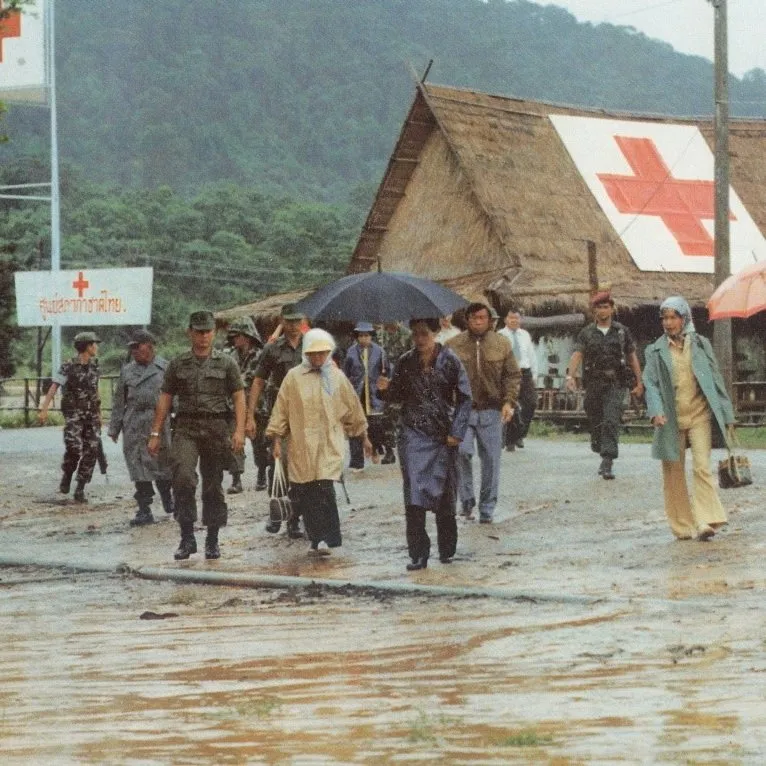
What distinguishes the Thai Red Cross under Queen Sirikit’s patronage is that it did not remain an emergency-only institution. Crisis response was the entry point.
After Khao Lan transitioned into the Rajakarun Centre, the focus shifted toward preparedness rather than reaction. Training programs were developed for disaster response, medical logistics, and humanitarian coordination. Staff and volunteers were taught how to operate before a crisis reached its peak instead of after systems were already overwhelmed.
This mattered because Thailand’s vulnerabilities were predictable. Floods, storms, border displacement, and later pandemics were (unfortunately) not hypothetical risks. Building capacity meant treating humanitarian response as a permanent function of public life.
Throughout this expansion, healthcare remained the anchor, but it was no longer isolated. Medical care was planned alongside shelter, food supply, sanitation, and education.
Mobilizing in a Generational Pandemic
When the COVID-19 pandemic hit and vaccines became available, the Thai Red Cross played a critical role in national distribution efforts, particularly for groups that often fall outside formal healthcare systems. Migrant workers, displaced populations, and people without stable documentation were included under a clear principle: public health only works if coverage is universal in practice.
By May 2022, the Thai Red Cross had administered approximately 1.8 million vaccine doses, operating alongside state health services rather than in parallel. Mobile units returned to prominence, this time to reach factories, border communities, and high-risk urban areas where access remained uneven.
Healthcare during the pandemic extended beyond vaccination. Community kitchens and emergency food distribution programs were activated to support households affected by lockdowns and job loss. Nutrition, mental health, and basic stability were treated as part of the same public health problem.
The pandemic made visible what had been built quietly over decades. Public health systems rooted in access, inclusion, and follow-up were able to respond quickly because they had been designed with crisis in mind from the beginning.
Public Health Without Borders

Diseases do not respect legal status, borders, or paperwork. Migrant workers, displaced people, and undocumented populations are part of the same public health ecosystem as citizens with full access to state services.
This is why Red Cross interventions consistently targeted groups that often fall outside formal systems. Mobile medical units were deployed to factories, border areas, and informal settlements. Vaccination drives were designed to reach people regardless of documentation. Food and essential supplies were distributed where economic disruption made health risks worse.
If one group cannot access care, outbreaks last longer, recovery takes more time, and the strain spreads outward. Inclusion reduces systemic risk for everyone and not just those receiving services. This approach avoided the trap of parallel systems. Red Cross programs were designed to operate alongside national health services, filling gaps rather than replacing the state.
What looks like generosity is actually strategy. Health systems work only when they account for how people actually live, move, and work.
A Legacy of Humanitarian Infrastructure
Taken together, these efforts reveal the real shape of Queen Sirikit’s public health legacy. Under her patronage, the Thai Red Cross evolved into a core pillar of Thailand’s humanitarian and public health landscape. It became an organization capable of rapid mobilization, long-term coordination, and sustained care when state systems were stretched or still developing.
That approach matters now more than ever. Climate-related disasters are increasing. Migration patterns are shifting. Public health threats move faster than borders. Systems that rely only on ideal conditions fail under pressure.
The Red Cross model that emerged under Queen Sirikit’s guidance was designed for pressure. It assumed disruption and planned for scale. It treated care as something that had to keep working even when everything else slowed down.
This is the continuity worth paying attention to. The institutions still operating today reflect a way of thinking about health that prioritizes readiness over reaction and access over appearance. The work continues because the structure was built to last.

 Paul Rujopakarn