As climate shocks grow more frequent and severe across the Asia-Pacific, the question has shifted from mitigation to adaptation. At the fifth annual Sustainability Week Asia held in Bangkok from March 25th – 26th, 2026, a panel on climate resilience underlined how disaster preparedness is reshaping how governments and companies alike are approaching the issue as a matter of risk, investment, and survival.
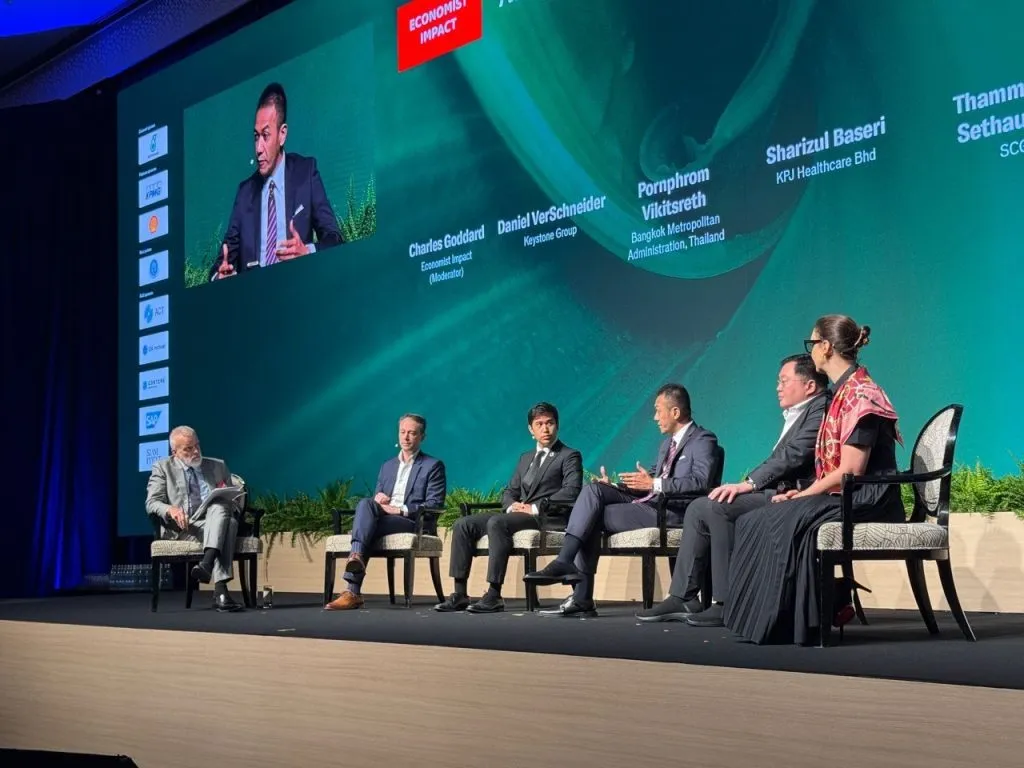
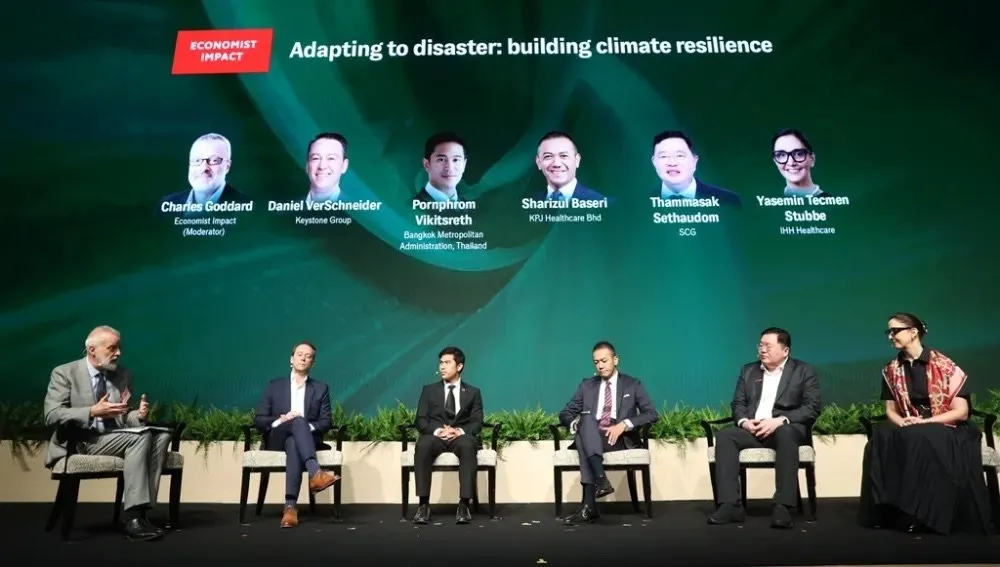
Moderated by Charles Goddard, Editorial Director for Economist Impact, the organizer of Sustainability Week Asia, the panel “Adapting to Disaster: Building Climate Resilience” brought together leaders from construction, healthcare, and urban governance to examine when climate risks cross the line from sustainability concern into a core strategic threat.
For Daniel VerSchneider, Chief Operating Officer and Director for Sustainability at Keystone Group, that shift happens when operations are disrupted. He cited the 2011 floods in Thailand, which crippled industrial production. From that perspective, investment in preparedness is a practical decision. The question becomes the cost of doing nothing.
His perspective is echoed in the healthcare sector. Sharizul Baseri, Group Chief Risk Officer of KPJ Healthcare, described how extreme weather affects service continuity, mobility, and patient access. As a result, KPJ Healthcare has transitioned from ESG (Environment, Social, and Governance) reporting to enterprise risk management that incorporates climate resilience.
One of the biggest barriers to preparedness is human psychology. Yasemin Tecmen Stubbe, Group Chief Sustainability Officer of IHH Healthcare, observed that many organizations only respond once a crisis hits — what she described as “the 6 a.m. call.” Yet companies are now facing overlapping disruptions, from pandemics to geopolitical tensions alongside extreme weather events. Disaster risk planning, she argued, must now account for the “worst of the worst” case scenarios.
In Bangkok, some of the scenarios have already come to pass.
Pornphrom Vikitsreth, Chief Sustainability Officer and Advisor to Governor of Bangkok for the Bangkok Metropolitan Administration, highlighted the structural vulnerabilities facing Bangkok, much of which sits below the level of the Chao Phraya River that runs through it. Only a few months after his administration came to power in 2022, the heaviest rainfall since the 2011 flood disasters inundated the city. While officials captured only a dozen risk points across the city, crowdsourced reporting through platforms such as Traffy Fondue identified hundreds of vulnerable locations, revealing gaps in traditional monitoring systems.
For Bangkok authorities, resilience depends on large-scale infrastructure such as drainage megaprojects, strategic maintenance of its intricate canal system, and addressing smaller, often overlooked factors, including household-level waste management that can bottleneck capacity.
From a corporate perspective, climate risk is also beginning to influence competitiveness. Thammasak Sethaudom, President and Chief Executive of Siam Cement Group (SCG), noted that while larger corporations are showing increasing focus on climate adaptation, smaller firms often lag behind due to limited awareness and resources.

Supply chains are evolving as a result, and companies that can maintain reliability during disruptions may command price premiums. In that sense, climate resilience is emerging as a competitive advantage.
The challenge, as Goddard pointed out, lies in financing. Thammasak pointed out that the return on investments in climate adaptation are “up in the air” and difficult to quantify.
Even so, panelists agreed that the framing needs to shift. Sharizul said that as disasters grow more frequent, climate resilience functions like insurance, and “It’s not whether we can afford to, it’s whether we can afford not to.”
Thammasak saw a path forward in “dual-use” investments: projects designed to reduce climate risk while also generating value. Such approaches may help align public and private incentives, particularly in rapidly growing urban areas.
What the panel made clear is that a broader shift is underway across Asia. As once-a-decade weather events become once-a-year, climate risk is moving to the center of the executive dashboard and reshaping the decisions Asian companies make about their supply chains and strategic investments.
For a region that is both highly exposed to climate impacts and central to global economic growth, Asia cannot afford the cost of business as usual.


 Paul Rujopakarn