

Makha Bucha Day (also, Magha Puja) is a religious celebration marking Lord Buddha’s teachings to his disciples.
As with most Thai religious holidays, Makha Bucha is celebrated according to the traditional lunar calendar, on the day of the full moon of the third lunar month. Though specific dates may vary, the event usually takes place in February or March. This year’s Makha Bucha Day falls on March 3rd.
What does “Makha Bucha” mean?
The term makha comes from the word “Magha” in Pali, and it refers to the third lunar month, while bucha can translate as “to worship,” both of which are derived from the Pali language used in Buddhist scripture. Therefore, the term Makha Bucha refers to a day intended for worship on the third lunar month.
Fourfold Assembly Day

According to Buddhist lore, Makha Bucha commemorates a legendary event that occurred at the Veluwan temple in India. Lord Buddha delivered his fundamental teachings, or Ovada Patimokkha, to his disciples. As the story goes, this meeting consists of four phenomena:
1. The event occurred on the day of a full moon during the third lunar month.
2. A total of 1,250 disciples gathered spontaneously, without prior appointment.
3. All of the disciples were “arahants,” or enlightened disciples.
4. All have been ordained by Buddha, making them his direct spiritual descendants.
Due to this chain of events, the meeting is referred to as the Chaturangasannibat or the Fourfold Assembly and is considered a religious miracle in Buddhist lore.
Historical celebrations of Makha Bucha
Historical celebrations of Makha Bucha are relatively obscure, but modern iterations can be traced back to the reign of King Rama IV, who formally decreed the tradition in 1851. Initially, the event was held in the Temple of the Emerald Buddha, where only those residing in the palace were allowed to enter.
This practice was then expanded under King Rama V, who believed that the celebration could be used to promote the faith in Thailand. The event itself was then established as an official public holiday in 1913, and has since been widely celebrated across the Kingdom.
Makha Bucha in Thailand
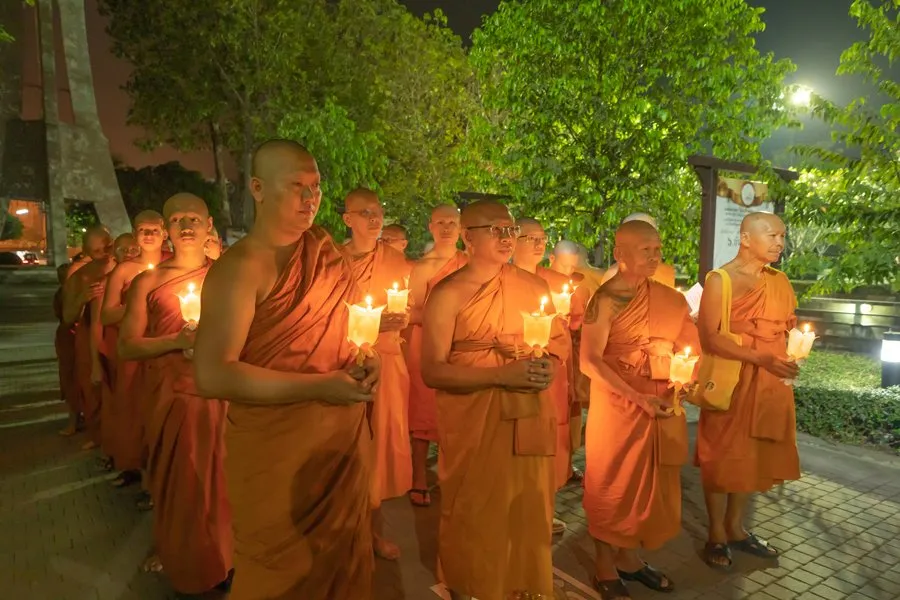
Although not as prominent as in the past, the event nowadays is celebrated by Buddhists far and wide, including in countries such as Cambodia, Laos, Myanmar, and Sri Lanka.
In Thailand, temples often organize wian thian or a candlelight procession around the ordination hall three times on the evening of Makha Bucha. Other traditions include giving alms, meditation, listening to Buddhist sermons, and closer adherence to the practice of the five precepts, including abstaining from alcohol.
Alcohol bans on religious holidays in Thailand
Those visiting Thailand during Makha Bucha should be aware that alcohol sales are prohibited during religious holidays in accordance with the 2008 Alcoholic Beverage Control Act.
The affected Buddhist holidays include Makha Bucha Day, Visakha Bucha Day, Asalha Bucha Day, Khao Phansa Day, and Ok Phansa Day (which is marked by several folk events, including the Buffalo Racing Festival, the Illuminated Boat Procession, and the Ghost Festival).
However, there are exceptions for the following locations:
- International airport passenger terminals
- Licensed hotels & entertainment venues
- Entertainment-type establishments at tourist attractions
- Venues hosting special national or international events with large attendance, subject to public safety screening measures