

A visit to the Kingdom of Thailand isn’t just a feast for the eyes but music to your ears. The Thai language has five tones, 44 consonants, and 21 vowels (creating 32 vowel sounds!).
Of course, what are sounds without meaning? One word you’ll hear again and again is jai (ใจ). As much as it is essential, this word is also extremely versatile and steeped in cultural significance.
What is “jai” and how is it used?

The Office of the Royal Society of Thailand’s online dictionary defines jai as that whose function is to feel, think, and know. This understanding of the heart is perhaps why so many Thai expressions based on the word jai aren’t just about feeling emotions but how people think. Here’s a look at some of these expressions.
| Thai word (Thai spelling) | Literal meaning | Translation |
| dee jai (ดีใจ) | good heart | to be happy |
| sia jai (เสียใจ) | ruined heart | to be sad |
| jeb jai (เจ็บใจ) | hurt heart | to be hurt emotionally |
| khao jai (เข้าใจ) | enter heart | to understand |
| thud jai (ตัดใจ) | cut heart | to let go |
| plien jai (เปลี่ยนใจ) | change heart | to change one’s mind |
So upon closer inspection, Thai is a very intuitive language that takes a basic word, like jai, and modifies it in creative ways.
Beginnings, endings, and opposites

Combining jai with the same modifying word used as a prefix or suffix can also affect its meaning. Consider these simple examples, where the modifier as a prefix describes a feeling or action, but as a suffix becomes a personality trait:
| Modifier | As a prefix | As a suffix |
| dee (ดี) good | dee jai (ดีใจ) to be happy | jai dee (ใจดี) kind |
| khaeng (แข็ง) hard | khaeng jai (แข็งใจ) to brace oneself | jai khaeng (ใจแข็ง) cold/callous |
| ron (ร้อน) hot | ron jai (ร้อนใจ) to be anxious/restless | jai ron (ใจร้อน) impatient |
Now here’s where it gets really fun! Look what happens when we combine jai with the next pairs of opposites.
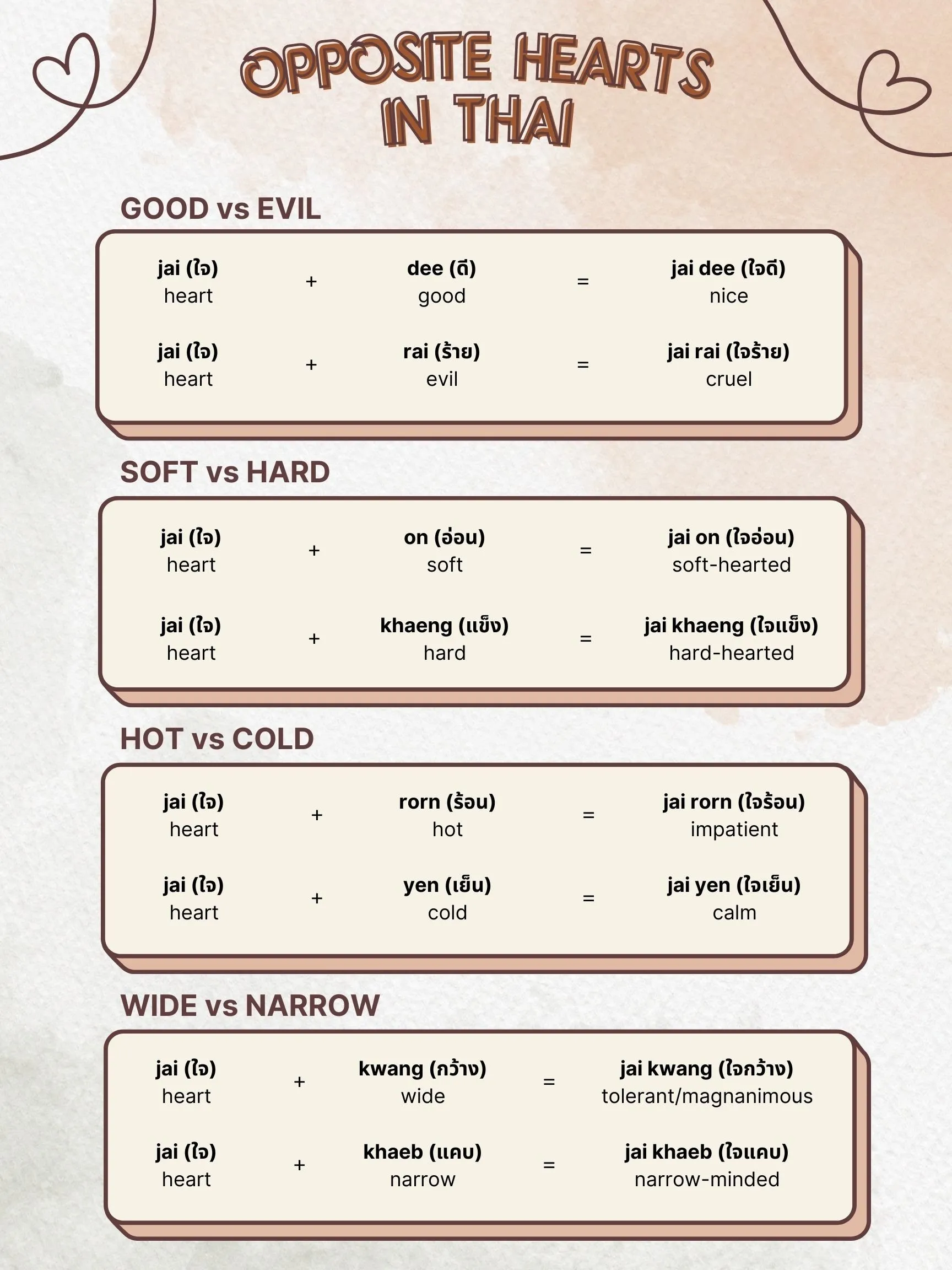
By applying opposite adjectives to jai, the Thai language intuitively describes the dichotomies of different personality traits and validates the duality we see in almost every aspect of life. While many people struggle with Thai tones and pronunciation, Thai vocabulary can be relatively straightforward compared to English, with only +40,000 words in Thai dictionaries compared to +155,000 in English dictionaries.
A mirror of the Thai soul

Based on all the above, jai helps tell you about a person’s character. For Thais in particular, it can tell you what makes us who we are and what we value. When we Thais talk about what we’re thinking, we often opt for the term jit jai (จิตใจ) which shows how our heads and hearts are very interlinked as jit (จิต) means mind or conscience. When describing others, we commonly refer to how much naam jai (น้ำใจ) or “water in their hearts” (compassion) they have as well as if they are given to being one who hen ok hen jai (เห็นอกเห็นใจ), the literal translation of which is “see heart” meaning sympathetic or empathetic.
A core Thai value and perhaps the hardest of all Thai values to describe is kreng jai (เกรงใจ). This is a feeling that arises whenever we want to ask for something. Basing it off its direct translation of “fearful heart,” you could say we worry about inconveniencing or imposing on someone. But it is so much more than that. Aside from hoping to be considerate, we also aim to remain respectful and polite and refrain from offending, disturbing, or making others feel obliged to do something. Kreng jai is all of those things rolled into one.
The “heart” of Thai music and lyrics
Few art forms are more universal than music. Look up the lyrics to a Thai song, and you’re bound to find a version of jai in there. Take, for instance, a few lines from Bell Warisara’s pop hit, “Ao Bhaka Ma Wong (เอาปากกามาวง)” or “Circle What You Like,” where the use of jai speaks to the uncertainty of knowing how someone feels about you.
ตอบฉันได้ไหมที่คิดในใจกับฉันคนนี้
thob chahn dai mai ti kid nai jai kub chahn khon ni
Can you tell me what you think in your heart of me?
ดาเมจไหน อะไรที่พอจะทำให้เธอโดนใจ
damage nai arai ti por ja tum hai ter dohn jai
What kind of impact would be enough to hit your heart?
Meanwhile, Nont Tanont’s “Toh Rim (โต๊ะริม) or “Melt,” which has an amazingly theatrical music video, uses jai to express both desire and satisfaction.
ก็ยากที่จะต้านทาน อดใจไม่ไหว
kor yahk ti ja thahn tahn ohd jai mai wai
I just can’t resist. I can’t hold back any longer.
แค่อยากจะรู้จัก ก็เธอดันน่ารักซะสาแก่ใจ
khae yahk jah roo jahk kor ter duhn nah rak sa sah kae jai
I just want to get to know you since you’re just too satisfyingly cute.
Finally, in Pop Pongkool’s pop ballad “สลักจิต (Carved into Your Mind)” featuring Da Endorphine, jai is used to express the feelings that linger for an ex-partner.
ยังดูเหมือนมีบางอย่างที่ฝังในใจ
Yung doo muean mee bang yang thee fang nai jai
Looks like there’s something buried in your heart.
คนที่ควรจะลืมแต่ทำไมหัวใจยิ่งจำ
Khon tee khuan ja luem tae tummai huajai ying jum
The person you should forget, why does your heart still remember?
An expression worth exploring

Jai seems simple at first but is the foundation of a multitude of satisfyingly nuanced expressions, blurring the line between heart and mind. But jai is just the tip of the iceberg when it comes to linguistic and cultural insights. The Thai language is full of visceral terms that have no direct translation, which often leave bilingual Thais scratching their heads and exclaiming with exasperation, “If only you could understand Thai!”

 Paul Rujopakarn
  Teerin Julsawad