

For one week in October, Bangkok will become one of the centers of the global economic policy world.
From October 12th to 18th, Thailand will host the 2026 Annual Meetings of the International Monetary Fund (IMF) and the World Bank Group at the Queen Sirikit National Convention Center (QSNCC), bringing together finance and development ministers, central bank governors, private-sector leaders, civil society organizations, academics, and media from around the world.
Thai organizers expect more than 15,000 delegates from 191 member countries. They have described the gathering as the “Olympics of Finance,” which gives some sense of its scale, although the week is less a single conference than a dense collection of official meetings, policy discussions, seminars, press briefings, and events taking place around the two institutions’ annual gathering.
Thailand last hosted the Annual Meetings in 1991. Now 35 years later, the meetings return to the same site, although QSNCC itself has since been completely redeveloped.
Here is what the Annual Meetings actually are, why they matter, and what Thailand plans to put on the table this year.
What are the IMF and World Bank?
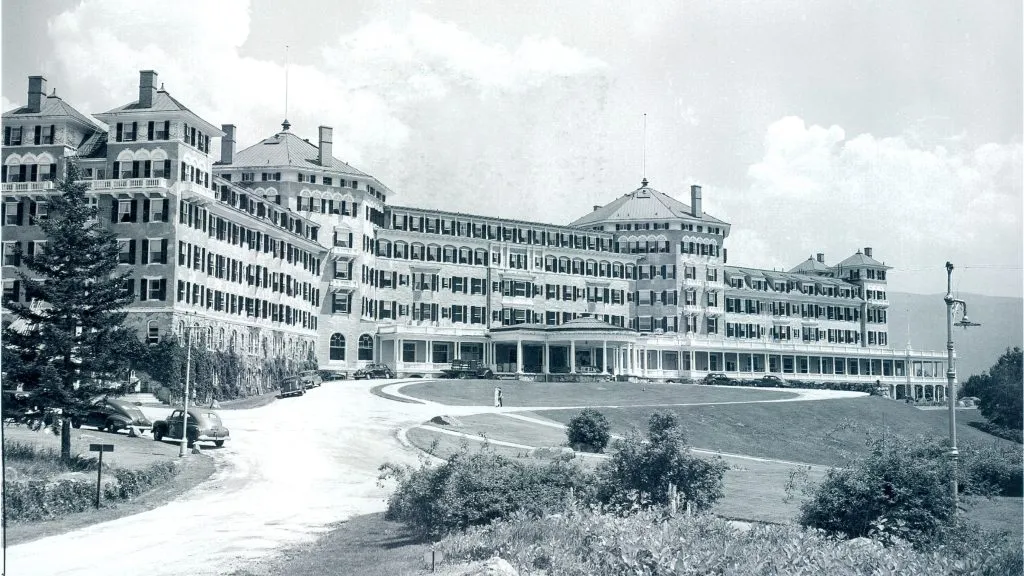
The Bretton Woods Conference was held at the Mount Washington Hotel in Bretton Woods, New Hampshire on July 1st, 1944. Source: www.worldbank.org
Both institutions trace their origins to the Bretton Woods Conference in New Hampshire in July 1944, when 730 delegates representing 44 countries met while World War II was still underway. Their task was to design a system of international economic cooperation for the postwar world.
The conference produced the agreements that created the IMF and the International Bank for Reconstruction and Development (IBRD), which later became part of what is now the World Bank Group.
Their jobs are related, but different.
The IMF focuses primarily on the international monetary system and macroeconomic stability. It monitors national and global economies, provides policy advice, lends to countries facing balance-of-payments problems, and provides technical assistance and training. It currently has 191 member countries.
The World Bank Group focuses more broadly on economic development and poverty reduction. It consists of five institutions, including IBRD and the International Development Association, which together are commonly referred to as the World Bank. The other three work with the private sector, provide political-risk guarantees, and facilitate the settlement of international investment disputes.
Once a year, the Boards of Governors of the IMF and World Bank Group gather for their Annual Meetings. Most years, those meetings take place at the institutions’ headquarters in Washington, D.C. Traditionally, every third year they are held in another member country.
The formal meetings sit alongside a much larger program of seminars, bilateral meetings, press conferences, civil society events, and discussions involving governments, central banks, businesses, researchers, and international organizations.
This year’s published program gives a sense of the range. The IMF will release its October “World Economic Outlook” and “Global Financial Stability Report” during the week, while sessions will cover subjects including artificial intelligence (AI), cross-border payments, cybersecurity, taxation in the AI era, food security, sovereign risk, and ASEAN’s place in a changing global economy.
Thailand will also host dedicated sessions on building resilience in a fragmented world and on the country’s economic path since it last hosted the meetings in 1991.
A History of Crisis and Salvation
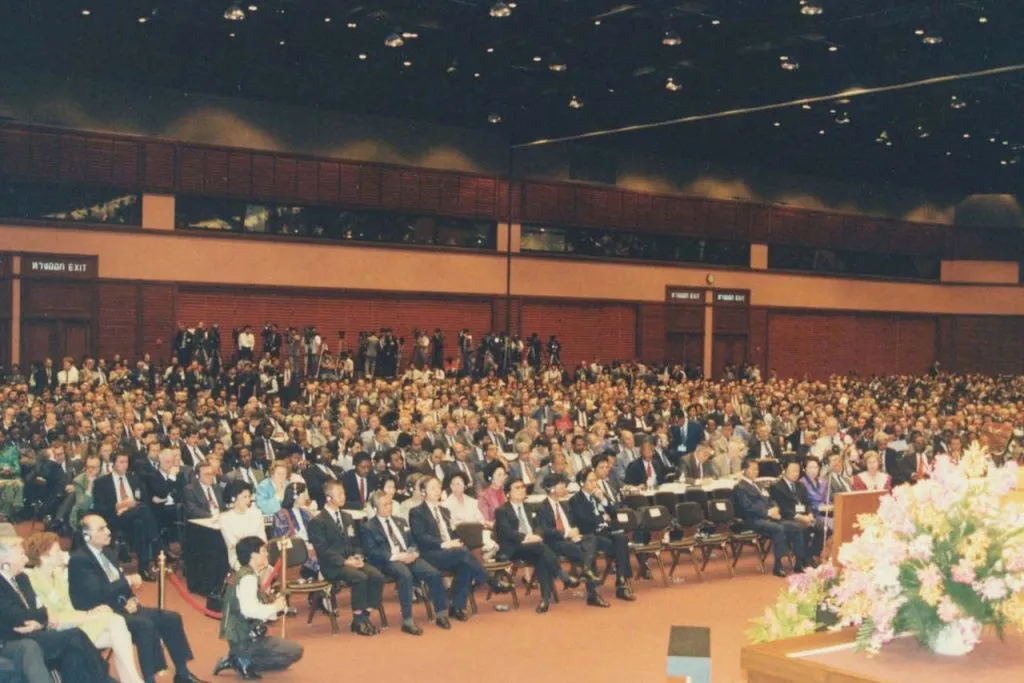
Thailand had first hosted the IMF-WBG Annual Meetings in 1991, which also took place at the Queen Siriki Convention Center. Source: www.bot.or.th
Thailand joined the IMF on May 3rd, 1949. For many Thais, however, the institution is most closely associated with the 1997 Asian financial crisis. In August of that year, the IMF approved a Stand-By Arrangement allowing Thailand to draw up to 2.9 billion special drawing rights (SDRs), then worth about US$3.9 billion, as part of the international response to the crisis.
Thailand completed repayment of its outstanding obligations under the arrangement in July 2003, ahead of the original repayment schedule.
That history gives the return of the Annual Meetings an additional layer of significance. Thailand is no longer meeting the IMF from the position it occupied during the crisis. It is hosting the institution’s global membership and using the week to present its own ideas about some of the economic problems countries now face.
There is a physical connection to the earlier meeting too.
QSNCC originally opened in 1991 to host that year’s IMF–World Bank Annual Meetings. The convention center was extensively redeveloped decades later and reopened in 2022. In October, the Annual Meetings will return to the site for which the original convention center was built.
The Road to Bangkok
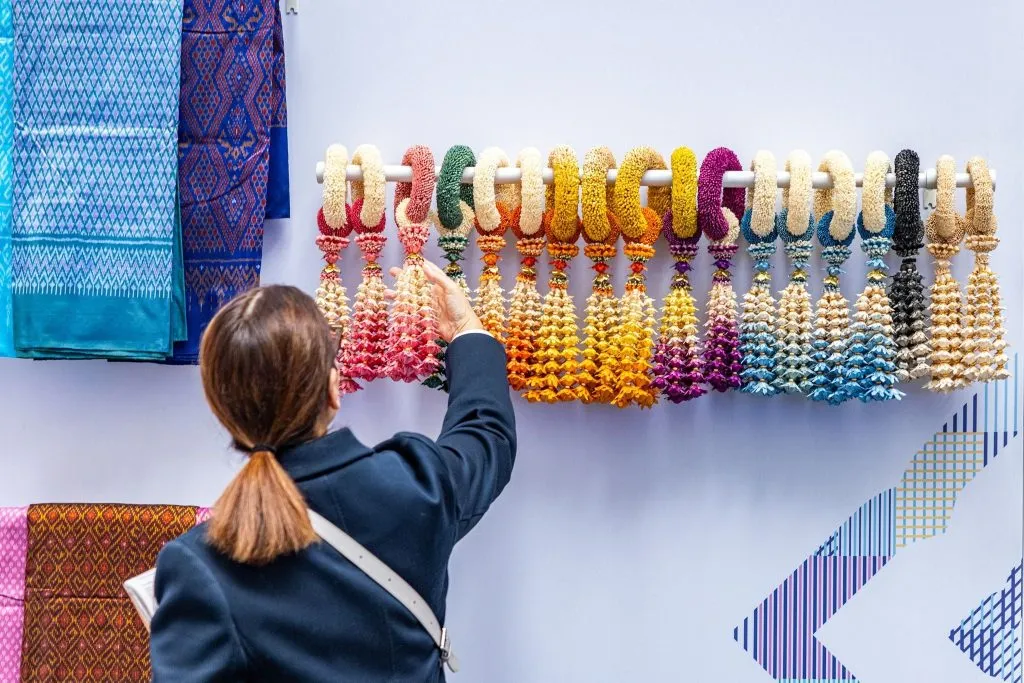
The Thailand booth at the Headquarters of the IMF and World Bank Group in Washington, D.C. featured Thai silk and phuang malai or flower garlands. Source: www.am2026thailand.go.th
Thailand has spent more than a year preparing for the event.
The official host website launched in August 2025, followed by a series of academic seminars, public events, training programs, and promotional activities under the “Road to Thailand” campaign.
At the 2025 Annual Meetings in Washington, Thailand previewed its role as the next host with a booth built around “The Art of Thai Weaving,” featuring handicrafts made from materials including rattan, bamboo, sedge, bulrush, and niyalo fiber. Visitors could try weaving pla tapian, or traditional woven fish, while performances introduced dance traditions from Thailand’s four regions.
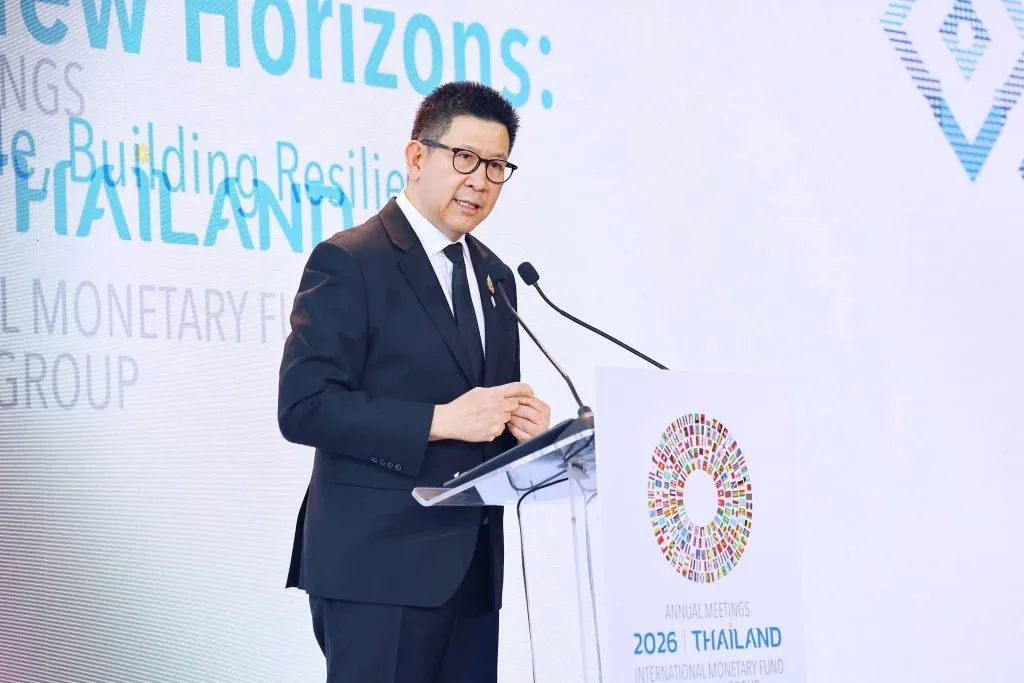
Deputy Prime Minister and Finance Minister Ekniti Nitithanprapas speaking at the unveiling of the landmark for the 2026 IMF-WBG Annual Meetings. Source: www.am2026thailand.go.th
In January 2026, Thailand formally introduced its host-country theme: “Thailand’s New Horizons: Empowering People, Building Resilience.”
The idea is deliberately tied to the 35 years since Bangkok last hosted the meetings. “Empowering People” emphasizes people-centered development and wider access to the benefits of economic growth, while “Building Resilience” focuses on the ability of economic and financial systems to withstand shocks ranging from geopolitical instability to climate change.
The preparations have involved the Ministry of Finance and the Bank of Thailand as co-hosts, alongside other government agencies, Bangkok authorities, the private sector, universities, communities, and student volunteers.
Those preparations have also included contingency planning. In early October, Deputy Prime Minister and Minister of Finance Ekniti Nitithanprapas inspected the event’s command center at QSNCC, where agencies have prepared and tested response plans for emergencies including floods, earthquakes, cyberattacks, and disease outbreaks.
The Soft Power Platform
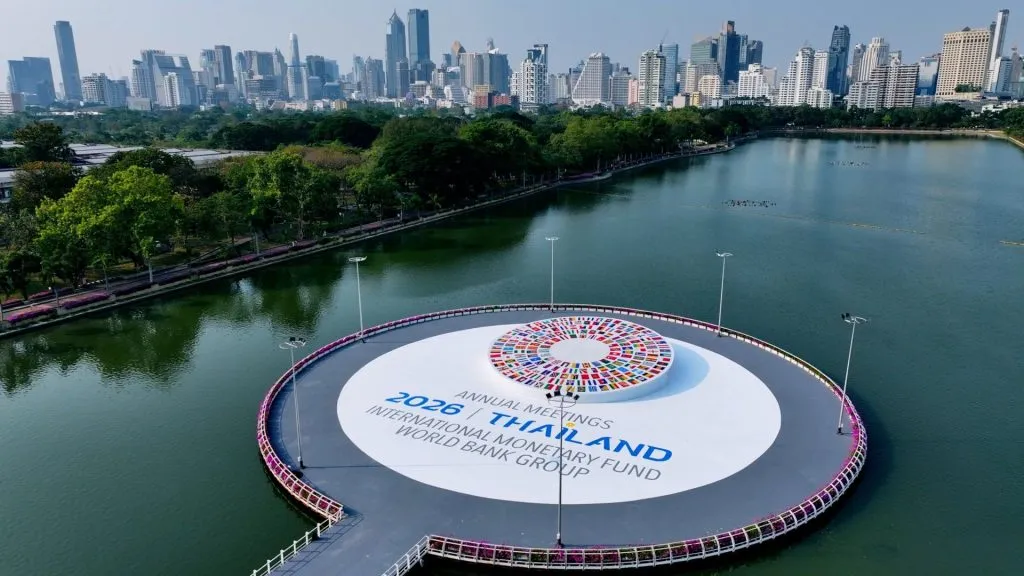
The commemorative landmark for the 2026 IMF-WBG Annual Meetings features the flags of the 191 participating countries and serves as the official welcoming point for all 15,000 delegates. Source: www.am2026thailand.go.th
Hosting more than 15,000 international delegates also gives Thailand a very large stage on which to present itself.
Some of that will be visible before delegates even enter QSNCC. An official AM2026 landmark has been installed at nearby Benjakitti Park as a public welcoming point for the meetings.
Inside the convention center, organizers are incorporating handwoven and local textiles from 21 provinces and 26 communities. 37 heritage patterns have been selected, including Tai Lue teen jok textiles, elephant-patterned pha khao ma, and “Buppha Borom Rachineenart” batik.
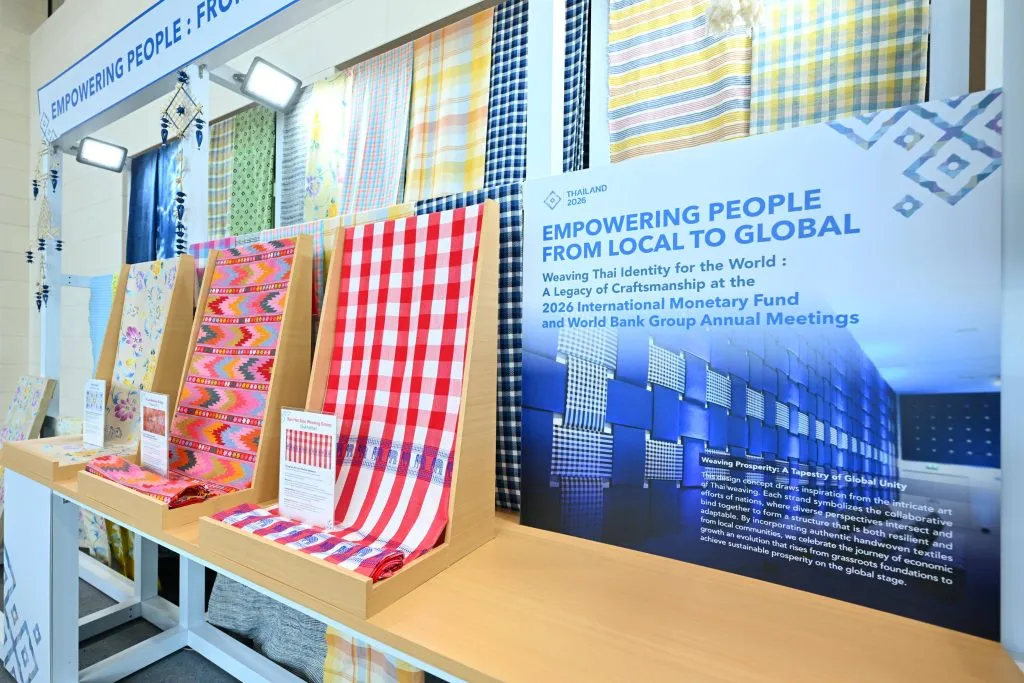
Thailand aims to leverage its platform as host country to strengthen its soft power, exhibiting Thai textiles and GI products. Source: @am2026_thailand Instagram account
The textiles are not being presented only as exhibits. Some are being incorporated into acoustic panels and interior decoration throughout the venue.
Thai geographical indication (GI) products will also be presented and served to delegates, including specially selected 100% Thai jasmine rice.
It is part of a broader effort to use the meetings to put local communities and products in front of an unusually international audience. But Thailand is also trying to make a policy contribution to the week, particularly in an area where it has considerable experience: digital finance.
The Bangkok Blueprint
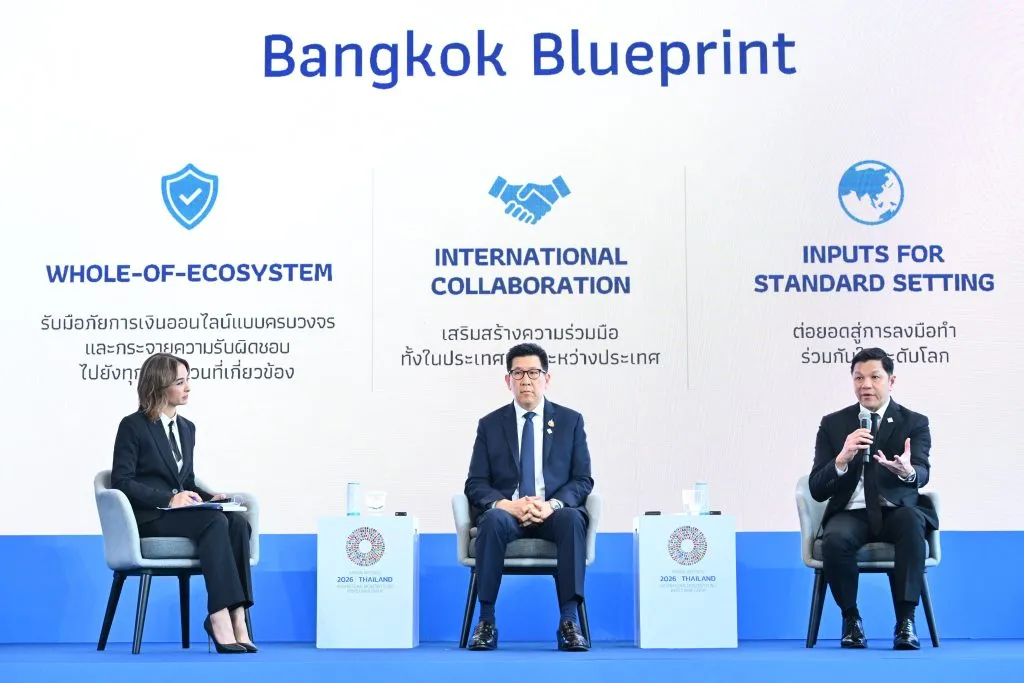
Deputy Prime Minister and Finance Minister Ekniti Nitithanprapas (center) and Bank of Thailand Governor Vitai Ratanakorn (right) speaking at the MOF-BOT Joint Press Conference. Source: www.am2026thailand.go.th
The host-country agenda is organized around four broad issues: digital and AI transformation for inclusive and resilient growth; resilience in a fragmented world; a new financial architecture for climate adaptation; and demographic change and the longevity economy.
Each corresponds to pressures Thailand is already dealing with at home.
The country is trying to raise productivity while adapting to rapid technological change. It is exposed to shifts in global trade and supply chains. As a net energy importer, it remains vulnerable to external energy shocks. And its aging population is changing the economics of work, health care, savings, and public spending.
One of Thailand’s most concrete contributions to the meetings will come from the Bank of Thailand.
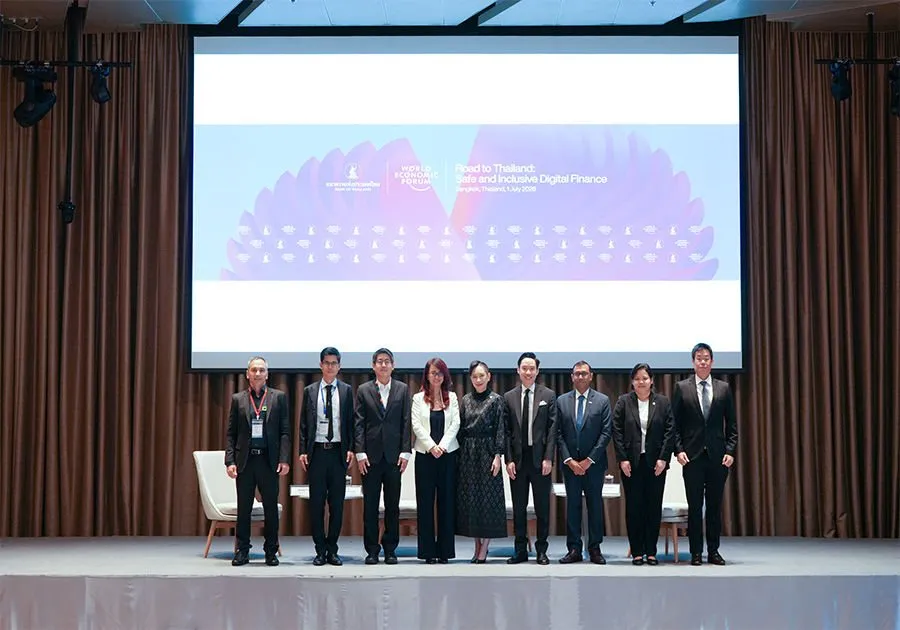
Ms. Chayawadee Chaiyanan, Assistant Governor, Corporate Relations Division, Bank of Thailand (middle), chairs the BOT workshop on Safe and Inclusive Digital Finance in collaboration with the World Economic Forum (WEF). Source: www.bot.or.th
Vitai Ratanakorn, governor of the Bank of Thailand, has framed the central bank’s agenda around “Safe and Inclusive Digital Finance (SIDF) for Financial Wellbeing,” drawing partly on Thailand’s experience with digital financial infrastructure such as PromptPay and cross-border QR payments.
The central concern is that making finance faster and more digital is not enough if the same systems expose people to fraud, cybercrime, or new forms of financial exclusion.
That work is feeding into the Bangkok Blueprint for Fraud-Resilient Financial Services, developed with the IMF and World Bank Group. The framework is intended to address areas including policy and legal foundations, fraud prevention and detection, cooperation between agencies and countries, and financial literacy and digital resilience.
It is no longer merely a proposal for the October meetings. The official IMF program now includes a launch of the Bangkok Blueprint on October 14th, followed by a separate implementation session later that afternoon.
Thailand at a Crossroads
Source: www.worldbank.org
The policy discussion comes against a less comfortable economic backdrop.
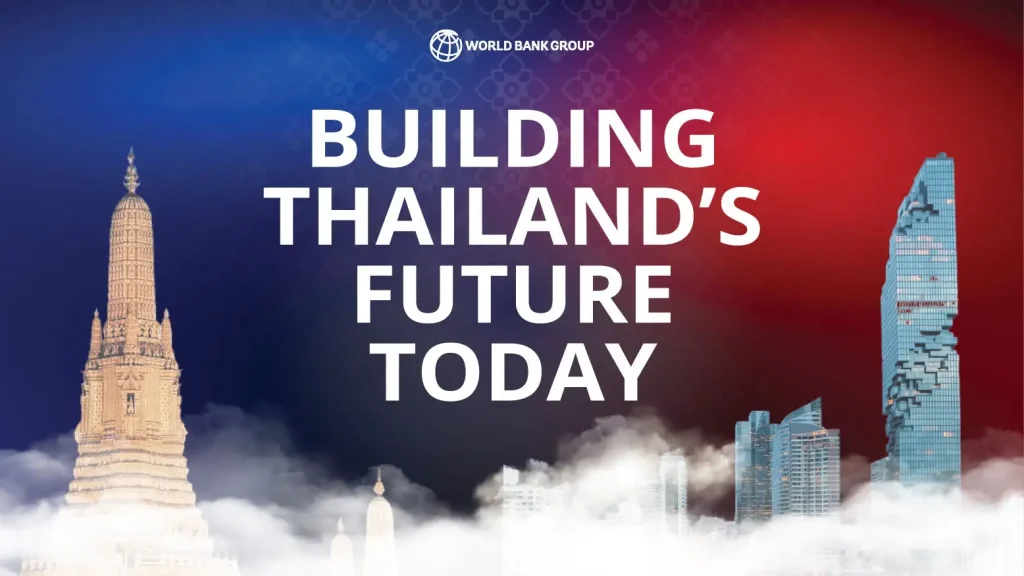
A new World Bank Group report, “Building Thailand’s Future Today,” argues that Thailand will need a substantial increase in productivity if it is to achieve its ambition of becoming a high-income economy by 2037.
Thailand has changed dramatically since it last hosted the Annual Meetings. According to the World Bank, the country has created around 11 million formal jobs and more than doubled GDP per capita over those 35 years.
Growth, however, has slowed.
The World Bank says Thailand would need average real GDP per capita growth of about 5.4% a year over the next decade to reach high-income status by 2037. Its current assessment points instead to familiar structural problems: weak investment and productivity growth, an aging population, skills constraints, and barriers that make it harder for businesses to compete, innovate, and grow.
Its proposed answer is built around two ideas: “upgrading” and “dynamism.”
Upgrading means moving more of the economy toward higher-value activities through technology, skills, innovation, and greater domestic value added. Dynamism means creating conditions in which more firms, workers, and cities can participate in that growth rather than concentrating opportunity among a relatively small group of companies and places.
Source: www.worldbank.org
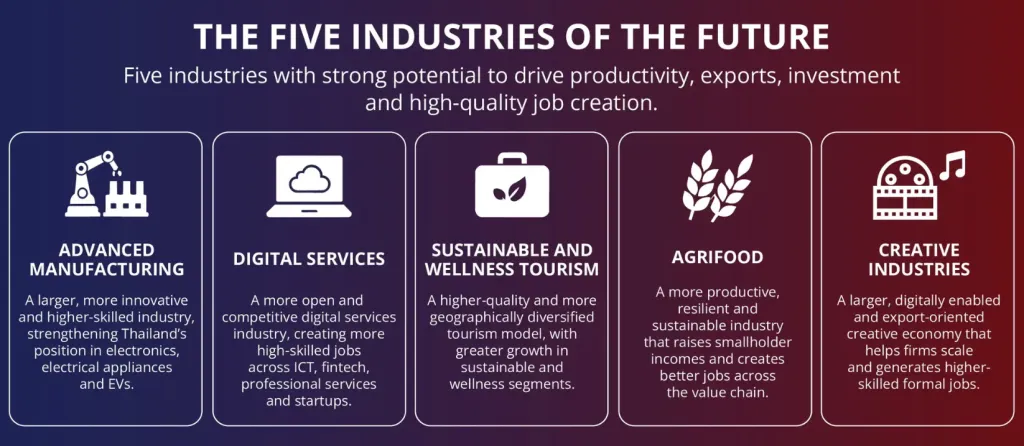
The report identifies five industries where Thailand already has advantages that could support its next phase of growth: advanced manufacturing, sustainable and wellness tourism, digital services, agrifood, and creative industries.
It also calls for investment in the workforce, stronger competition and innovation among firms, and a larger economic role for secondary cities alongside a more productive, green, and innovative Bangkok.
Those questions are not separate from AM2026. They help explain why Thailand has chosen resilience, technology, climate adaptation, and demographic change as the issues it wants to emphasize while the global economic policy community is in town.
Key Activities to Watch
The Annual Meetings officially run from Monday, October 12th, through Sunday, October 18th, with the main plenary scheduled for Friday, October 16th.
The IMF’s major economic publications will arrive during the week. The October “World Economic Outlook” is scheduled for release on October 13th, alongside the main chapter of the ”Global Financial Stability Report.” The “Fiscal Monitor” follows with a press briefing on October 14th.
There will also be discussions focused specifically on the region and the host country. “ASEAN in a Changing Global Landscape” is scheduled for October 14th, while Thailand’s program includes a finance minister-led event on resilience and a seminar looking back at the country’s economic trajectory from Bangkok 1991 to Bangkok 2026.
Source: www.imf.org
Not everything happening around AM2026 will be part of the formal IMF and World Bank governance process. Much of the significance of a week like this comes from having finance ministers, central bankers, development institutions, investors, economists, civil society groups, and media in the same city at the same time.
For Thailand, that creates an opportunity to do two things at once: participate in the global debate over where the economy goes next, and invite that same audience to look closely at the choices Thailand is making at home.
35 years after the Annual Meetings first came to Bangkok, those choices look very different. The questions facing Thailand in 2026 are less about recovery from a single crisis than how to generate growth in an economy facing technological disruption, geopolitical fragmentation, climate risk, and demographic change.
For a week in October, many of the institutions wrestling with those same questions elsewhere will be doing it from Bangkok.

 Paul Rujopakarn