At a time when cybercrime is reshaping global security, Thailand has stepped onto the international stage this week at the Global Fraud Summit in Vienna, positioning itself as both a frontline state and an emerging leader in the fight against transnational scams.
Held at the Vienna International Centre and co-organized by the United Nations Office on Drugs and Crime and INTERPOL, the summit convened governments, law enforcement agencies, and private-sector players to confront the rapid evolution of fraud networks, particularly those rooted in Southeast Asia.
Thailand’s delegation, led by Foreign Minister Sihasak Phuangketkeow, arrived with the clear aim of emphasizing that online scam operations have, over time, escalated from regional criminal enterprises to the level of growing global security threats.
The US$40 billion threat of scam networks
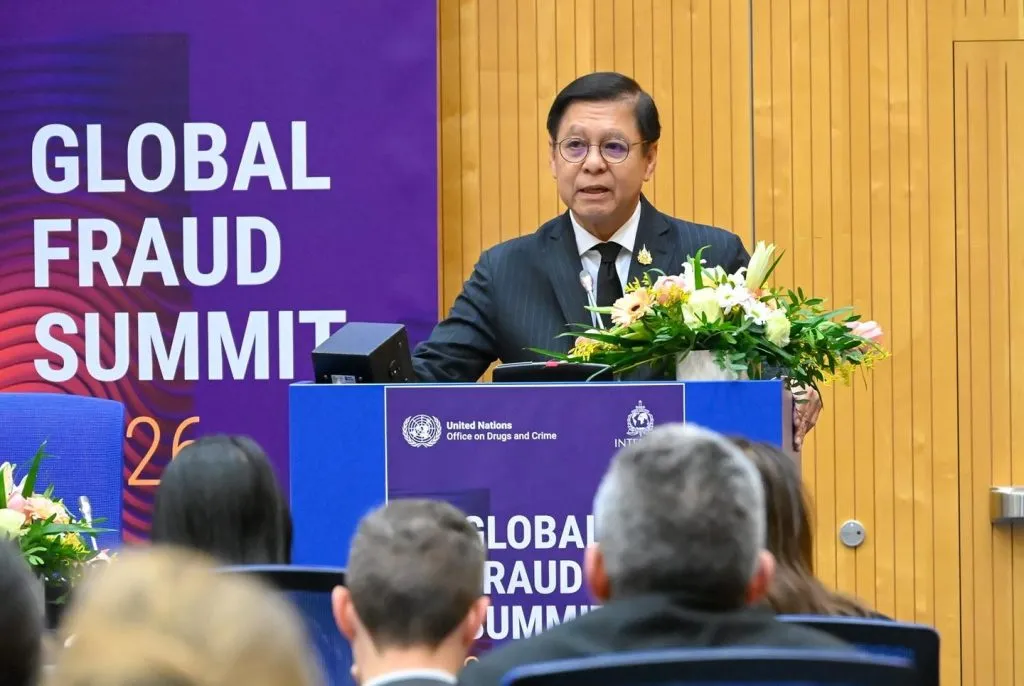
In his opening remarks, Minister Sihasak warned that online fraud is generating over US$40 billion in annual losses across East and Southeast Asia, linking the issue to human trafficking, forced labor, and broader human rights violations.
Noting that these crimes affect millions, he underscored how scam centers exploit weak governance and gaps in cross-border enforcement.
Thailand, he noted, has been directly impacted both as a target and also as a transit and response hub. Since early 2025, Thai authorities have helped repatriate more than 13,000 victims trafficked into scam operations spanning over 40 countries.
Taken together, these efforts point to a broader reality that while Southeast Asia sits at the epicenter of the crisis, the region is very much also at the heart of potential solutions.
Thailand’s call to action against cybercrime

The Thai delegation has also used the summit to showcase a shift from domestic enforcement to coordinated global action.
The Kingdom has elevated cybercrime to a national agenda, establishing specialized committees and expanding cooperation with international partners. Recent joint operations with agencies, including the U.S. Federal Bureau of Investigation (FBI) and global tech firms, led to the shutdown of more than 150,000 scam-linked accounts and multiple arrests.
At the summit, Thailand went further by endorsing two key frameworks, namely the “Call to Action on Combating Fraud” and a global public-private partnership model designed to tighten coordination between governments and tech companies.
Foreign Minister Sihasak also called for stepped-up measures, including sharper intelligence-sharing, faster cross-border investigations, and stronger asset-tracing mechanisms to prevent cyberspace from becoming a safe haven for criminal networks.
Collective action driven by diplomacy


On the sidelines, Thailand engaged in bilateral talks with European and Asian partners, including Austria, the United Kingdom, and Singapore, aiming to deepen cooperation on fraud as well as across broader political and regional issues.
“Countries that allow such criminal operations to take place must demonstrate the strongest political will and commitment to eradicate these problems,” Sihasak said, adding that Thailand is ready to confront fraud in all forms, especially online scams.
As scam operations grow increasingly sophisticated and borderless, leadership will ultimately depend on the ability to unify fragmented global efforts into coherent and coordinated action to achieve tangible progress.