

The beauty of Thai culture goes beyond the natural landscapes you see or the diverse cuisine you taste; it’s also heard in the musicality of its language. The Thai language has five tones, 44 consonants, and 32 vowel sounds, making it one of the more challenging languages for English speakers to master.
For many newcomers, the tonal nature of Thai and its unique writing system can feel intimidating at first. Yet those who immerse themselves often find the language to be a doorway into a deeper understanding of the culture.
Thailand NOW’s Culture Compass: Thai Language Explained shares some unique idioms, the variety and versatility of key words, and what lies at the end of the Thai-language learning tunnel.
Table of Contents
1. Idioms with a Cultural Twist
2. The Many Shades of “You”
3. Getting to the “Heart” of Thai Culture
4. Building a Life in Thailand
Idioms with a Cultural Twist
Language is a mirror of the culture, and Thai idioms offer colorful insights into the values and worldview of Thai society.
Take, for example, pak chee roy na (ผักชีโรยหน้า), or “to sprinkle cilantro on top,” which critiques superficial gestures that make something appear better without addressing the root problem. Or phid thong lang phra (ปิดทองหลังพระ), “to paste gold leaf onto the back of a Buddha statue,” which praises those who do good quietly, without seeking recognition. This expression is even referenced in the Thai name of the Royal Initiative Discovery Foundation (มูลนิธิปิดทองหลังพระ สืบสานแนวพระราชดำริ).
Rice farming has been a major part of Thai agriculture, so it’s no surprise that it features in Thai idioms. One expression, tam na bon lang kon (ทำนาบนหลังคน) or “to grow rice off other people’s backs,” means to exploit others for personal gain.
Phid thong lang phra (ปิดทองหลังพระ), “to paste gold leaf onto the back of a Buddha statue,” which praises those who do good quietly, without seeking recognition. This expression is even referenced in the Thai name of the Royal Initiative Discovery Foundation (มูลนิธิปิดทองหลังพระ สืบสานแนวพระราชดำริ).
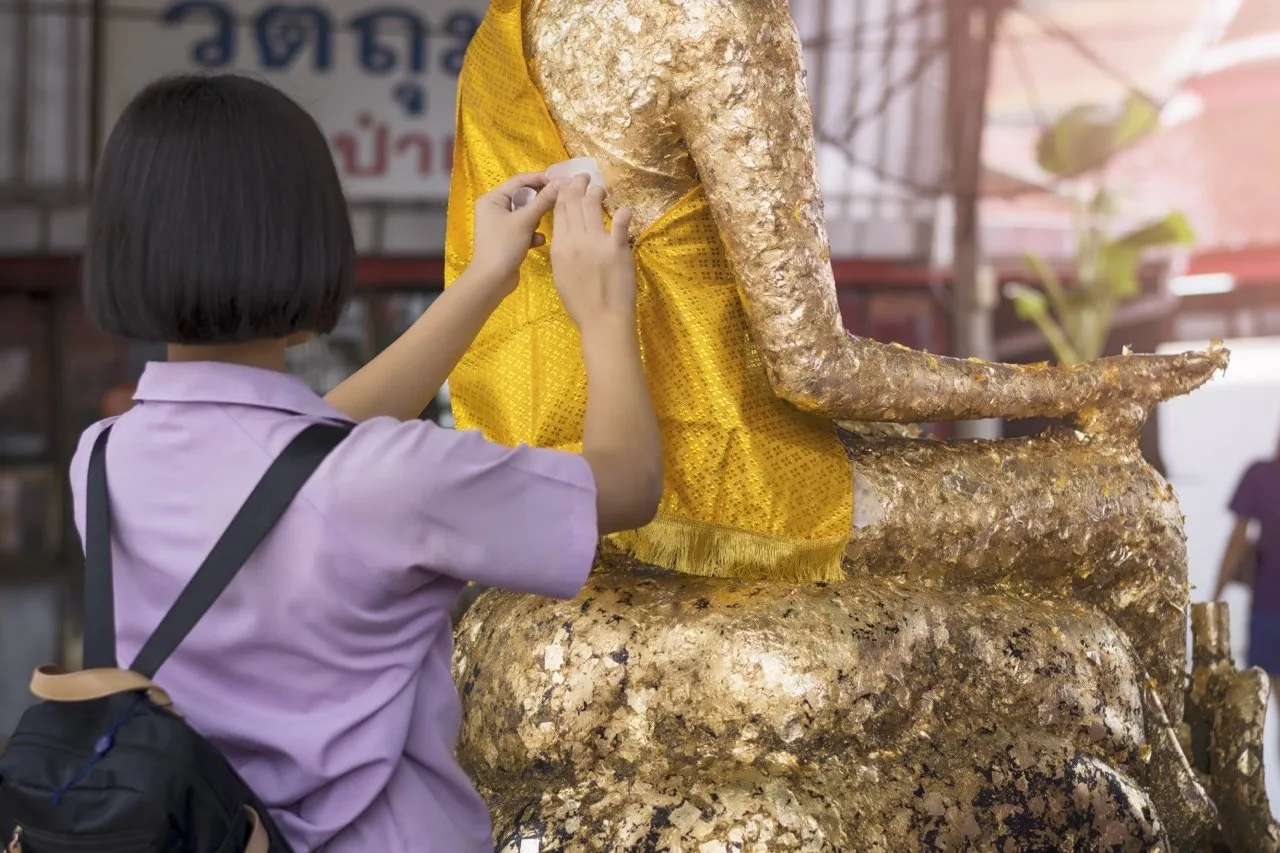
These expressions come from everyday life but like all idioms, echo a culture’s traditional way of life. In this case, we see references to Thai cuisine, Thai agriculture, and Theravada Buddhism.
The Many Shades of “You”
One of the most nuanced aspects of Thai is how people address each other. Unlike English, which uses a universal “you,” Thai has a rich spectrum of second-person pronouns reflecting formality, intimacy, and social status.
The polite and neutral khun (คุณ) is often used with strangers and colleagues. In formal settings, one might use tan (ท่าน). Among close friends or peers, however, it’s common to hear ter (เธอ), gae (แก), or eng (เอ็ง). These variations signal friendliness, warmth, and social belonging.
Expats often experience this firsthand. They may start off as khun, but with time and trust, may earn more familiar or affectionate forms of address, finding themselves woven into the social fabric of Thai life.
However, it’s important to note that just as impolite pronouns can signal closeness in the right context, polite ones can feel cold or distant in the wrong one. While khun is a respectful and generally safe choice, it can also create emotional distance. When used with a friend or loved one, it may even hint at annoyance or disapproval.

What can be confounding to some English speakers is that Thai people are also constantly blurring the lines between themselves and others.
Many second-person pronouns are also used as third-person ones. For instance, tan and ter also work as third-person pronouns to mean “them (singular).” It is also very common to use rao (เรา) or “we” to refer to “you.” By the same token, khao (เขา), which means “they (singular),” can be used to mean “I.”
For example, instead of Mook saying, “I went to the store” in Thai, she could refer to herself in second-person perspective and say, “She went to the store.” Linguistically speaking, Thais are constantly seeing themselves from other people’s perspectives!
Getting to the “Heart” of Thai Culture
If there’s one word that encapsulates Thai culture, it’s jai (ใจ), meaning “heart” or “mind.” Jai is everywhere in the language, used in countless expressions to describe thoughts, feelings, and social instincts.
Using contrasting adjectives with jai, Thai intuitively describes personality dichotomies and the dualities found throughout life. Although its tones and vowels can be challenging, Thai vocabulary is relatively compact. Thai dictionaries contain about 40,000 words, compared with over 155,000 in English dictionaries.

Among these, none is more culturally revealing than kreng jai (เกรงใจ), which conveys a deep sensitivity to how one’s actions might inconvenience or impose on others. It’s a mix of politeness, hesitation, respect, and empathy: an emotional calculus that governs much of Thai social interaction.
A great way to pick up Thai is through music, where the true versatility of the word jai is on full display. For example, the hit T-Pop song, “พบรัก (Phop Rak)” by Ink Waruntorn uses three variations: hua jai (หัวใจ) or “heart,” lambak jai (ลำบากใจ) or “burdensome,” and mod jai (หมดใจ) or “whole-heartedly.”
Building a Life in Thailand
Learners like Chulalongkorn University Professor Dr. Jessica Vechbanyongratana have succeeded not just through study, but by living day-to-day in Thai-speaking communities. Dr. Vechbanyongratana, now a naturalized Thai citizen, shared her experiences learning Thai and building a life here.
Though she teaches in English, she often uses Thai to connect with her students personally, helping bridge language gaps and build trust.
“I find that Thai students, especially those who want to challenge themselves to potentially study in the US or usually UK, it’s an opportunity for them to practice their English in a safe environment that they wouldn’t necessarily have with other staff,” said Dr. Vechbanyongratana.
“Using Thai as the community language allowed for both me and my children to be actively involved in decision-making and in religious and cultural activities,” she says.

For those eager to learn Thai, the journey can be as rewarding as it is difficult. From immersive, five-sense approaches to structured lessons in reading and writing, Thai language learners are encouraged to explore what works best for them.
The key is consistency and curiosity, because learning Thai isn’t just about mastering tones or memorizing vocabulary. It’s about tuning into a culture that values harmony, humility, and heart.
Thailand NOW’s Culture Compass guides readers through the cultural landscape of Thailand with a curated list of interconnected stories that, together, present a holistic map of how identity, tradition, economy, and policy intersect in the modern Thai society.
Download Culture Compass: Thai Language Explained


 Paul Rujopakarn