

IMF-World Bank Meetings kick off in Bangkok with AI and inclusive growth in spotlight
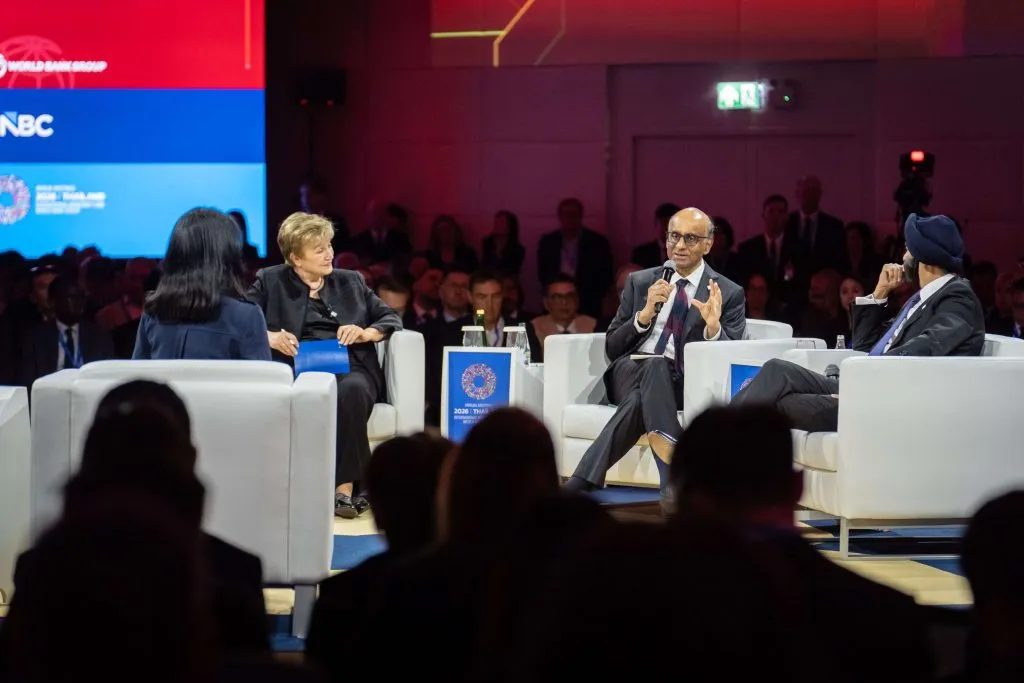
Source: www.am2026thailand.go.th
BANGKOK, 12 Oct 2026: The 2026 IMF-World Bank Group Annual Meetings opened in Bangkok on Monday, October 12th, 2026, with a focus on how artificial intelligence can drive economic growth and create jobs in developing economies, as policymakers grapple with tech disruptions, demographic shifts, and mounting global economic pressures.
More than 15,000 delegates from 191 countries are gathering at the Queen Sirikit National Convention Center for the meetings, which run through October 18th. The event marks Thailand’s first time hosting the annual meetings in 35 years, bringing global financial leaders together at a time when economic resilience and international cooperation face growing challenges.
Alongside policy discussions, Thai Prime Minister Anutin Charnvirakul presided over the opening of Thailand’s pavilion. The pavilion’s exhibition, “The Royal Legacy: Empowering People, Building Resilience,” showcases seven decades of royal development initiatives built around community-led solutions, nature-based approaches, and resilience to economic and environmental shocks.
Small AI offers opportunities for developing economies
The opening “Small AI: More and Better Jobs” forum explored how affordable, purpose-built AI could improve productivity and expand employment without requiring costly computing infrastructure associated with large AI models.
World Bank Group President Ajay Banga and Singapore President Tharman Shanmugaratnam emphasized the potential for targeted AI applications in agriculture, healthcare, and education, particularly in emerging markets where access to technology remains uneven.
Deputy Prime Minister and Finance Minister Ekniti Nitithanprapas outlined plans to integrate the “Nok Krajib” AI assistant into government mobile wallet applications, supporting nearly one million small merchants in managing their businesses. He also highlights skills-development programs designed to connect major tech investments with workforce training
The discussion underscored the importance of ensuring that technological advances translate into productive employment instead of deepening disparities. Tharman warned that economic growth alone doesn’t guarantee sufficient job creation, calling for closer public-private cooperation to help graduates enter the workforce and for education systems to place greater emphasis on practical skills and workplace experience.
Closing the skills gap
At a separate Youth Dialogue moderated by IMF First Deputy Managing Director Dan Katz, participants examined how AI could help younger generations navigate a rapidly changing labor market.
Aukrit Unahalekhaka, co-founder and chief executive of Thai agritech company Thara Green, said smartphone-based AI tools could substantially expand farmers’ productive capacity. With farmers accounting for roughly a third of Thailand’s population, he said accessible technology could enable individual farmers to manage land more efficiently, potentially increasing the area they oversee from 10 to 40 acres.
Sarah Rauzana, chairperson of the ASEAN Youth Organization, highlighted the gap between young people’s enthusiasm for AI and the digital skills employers increasingly demand. She pointed to the AI Ready ASEAN initiative, which has reached over 350,00 young people and 500 educational institutions.
Balancing innovation and growth
The meetings also take place against a challenging global backdrop, with geopolitical tensions and energy market pressures as well as public debt and widening inequalities threatening growth prospects.
The discussions on AI reflect a broader question facing policymakers of how to harness tech investments while ensuring the benefits reach smaller businesses, vulnerable workers, and developing economies.
Juti Krairiksh, a Phitsanulok MP from the Bhumjaithai Party and chairman of the House of Representatives Committee on Finance, Fiscal Policy, Financial Institutions and Financial Markets, said hosting the IMF-World Bank Meetings reflects Thailand’s readiness and credibility on the global stage. “Trust is earned, cannot be bought,” he said. “Stability is the backbone of effective economic policy.”
As delegates continue their discussions this week, the challenge will be translating these priorities into practical policies that sustain growth while expanding opportunities and strengthening international economic cooperation.

 Teerin Julsawad
  Paul Rujopakarn