

Thailand’s four-year program to attract affluent residents and highly skilled professionals is showing measurable economic returns, with more than 12,000 foreigners approved under its Long-Term Resident (LTR) Visa program since its launch in 2022.
The Board of Investment (BOI) said the program has generated about THB43 billion (US$1.28 billion) in economic value, including visa fees, domestic spending, direct investment, and tax revenue generated by highly skilled professionals.
Key Takeaways
- Thailand’s Board of Investment reports that 12,010 foreigners have been approved under the Long-Term Resident (LTR) Visa program since its 2022 launch, generating about THB43 billion (US$1.28 billion) in economic value.
- BOI Secretary-General Narit Therdsteerasukdi framed the LTR visa as a strategic pillar to attract global talent as Thailand absorbs a new wave of advanced technology investments.
- The program targets four categories, with 4,561 Wealthy Pensioners, 737 Wealthy Global Citizens, 1,779 Highly-Skilled Professionals, and 1,043 Work-from-Thailand Professionals, plus 3,891 dependents.
- A one-stop online application system launched in September links the consular affairs, immigration, employment, and revenue agencies, supported by an expat services center at One Bangkok.
- The program averages over THB3.6 million in economic value per recipient, supporting Thailand’s strategy of attracting fewer, higher-value foreign residents beyond traditional tourism.
The longer-stay economy

The LTR program was designed to go well beyond conventional tourism by targeting foreigners with the financial means, expertise, or professional credentials to make longer-term contributions to Thailand.
Of the 12,010 approved recipients, 4,561 are classified as Wealthy Pensioners and 737 as Wealthy Global Citizens. Another 1,779 are Highly-Skilled Professionals, while 1,043 are Work-from-Thailand Professionals employed by overseas companies. Dependents account for 3,891 recipients.
The mix gives the program an unusually broad economic footprint. Long-term residents spend on everything from housing and healthcare to food and transportation, with wealthy retirees and global citizens bringing purchasing power into local communities. Professionals and executives add investment, employment, and specialized expertise.
The United States is the largest source of LTR recipients, with more than 2,400 approvals, followed by Japan with over 1,300 and the United Kingdom with more than 1,000.
A talent pipeline for future industries

The more enduring payoff for Thailand is talent. Among Highly-Skilled and Work-from-Thailand Professionals, 54% occupy executive positions and another 36% are professionals in various fields.
Japanese nationals make up a particularly significant share of the highly skilled category, reflecting Japan’s longstanding role in Thailand’s automotive and precision-electronics industries.
“The LTR visa is a strategic pillar to attract global talent as Thailand absorbs a new wave of advanced technology investments,” said BOI Secretary-General Narit Therdsteerasukdi. “Drawing top-tier executives and technical specialists from around the world is vital to strengthening our national competitiveness and securing technology transfers from international partners.”
The presence of that expertise can in turn help deepen knowledge transfer and ensure that new investment builds capabilities within Thailand, rather than simply adding production capacity.
Streamlining the entry process
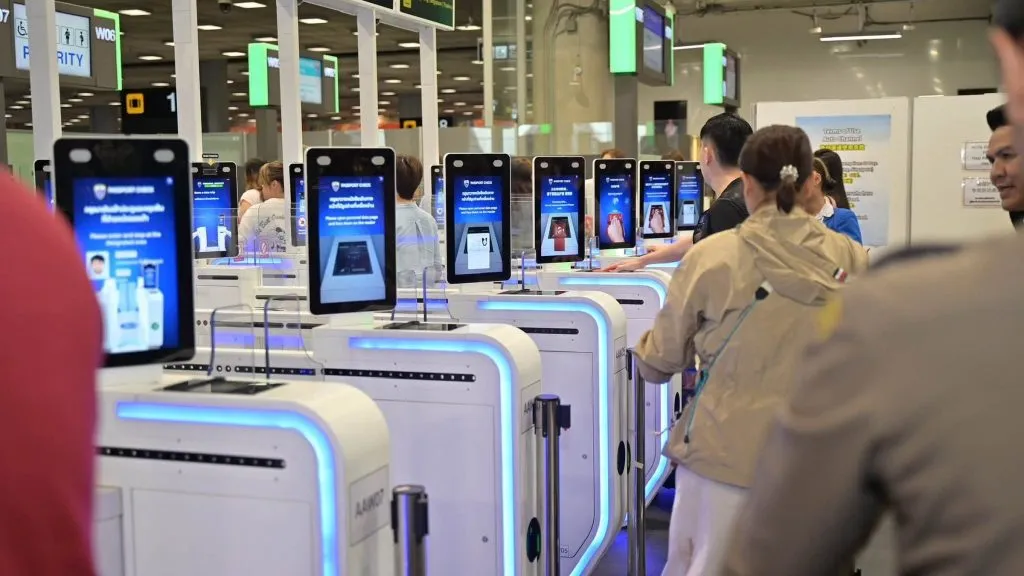
Passengers and officials beside automated passport-control gates at Suvarnabhumi Airport.
Source: TAT Newsroom
The government is also seeking to slash bureaucracy, one of the longstanding obstacles to attracting international talent.
In September, the BOI launched an online LTR application system connecting the Department of Consular Affairs, Immigration Bureau, Department of Employment, and Revenue Department in a single process. A one-stop Thailand Investment and Expat Services Center at One Bangkok provides additional support.
The strategy reflects a broader national effort towards competing globally for people whose long-term presence can bring spending, expertise, and investment into the Kingdom
With THB43 billion already attributed to the program, equivalent to over THB3.6 million per recipient, the LTR Visa is offering Thailand a compelling argument that attracting fewer, higher-value foreign residents can generate economic returns well beyond the traditional tourism model.

 Teerin Julsawad