

Thailand recently attended a major ASEAN-EU business gathering in Manila, The Philippines, where the country is positioning itself as a regional manufacturing and investment hub, while pushing for the conclusion of its long-running free trade negotiations with the European Union.
At the 12th ASEAN-EU Business Summit on September 22nd, Thai Trade Representative Werapong Prapha joined trade officials from across Southeast Asia for discussions on advancing ASEAN’s trade agenda amid a more fragmented global economy.
The summit came as the EU and Philippines announced a substantial agreement on their bilateral free trade deal, with negotiations with Thailand and Malaysia also approaching a critical stage. European and ASEAN business leaders stressed that agreements on paper would need to translate into investment, jobs, and stronger regional supply chains.
Key Takeaways
- Thailand aims to conclude its free trade agreement with the European Union by the end of 2026, with 15 of 24 chapters already negotiated and a 10th round held in Thailand.
- Thai Trade Representative Werapong Prapha framed Thailand as a reliable European partner built on sustainability alignment, reduced trade barriers, and domestic economic reform.
- The Thailand-EU FTA will cover investment, intellectual property, government procurement, energy, agriculture, and digital trade, pushing Thailand into higher-value supply chains.
- The EU-ASEAN Business Council found that 78% of surveyed businesses expect trade and investment in ASEAN to rise, while Thailand has launched its “Regulatory Guillotine” to modernize over 7,000 regulations and is pursuing OECD membership.
- With Vietnam and Malaysia already holding EU trade deals and Thailand set to chair ASEAN in 2028, the EU relationship is central to Thailand’s regional investment strategy.
A deal beyond trade
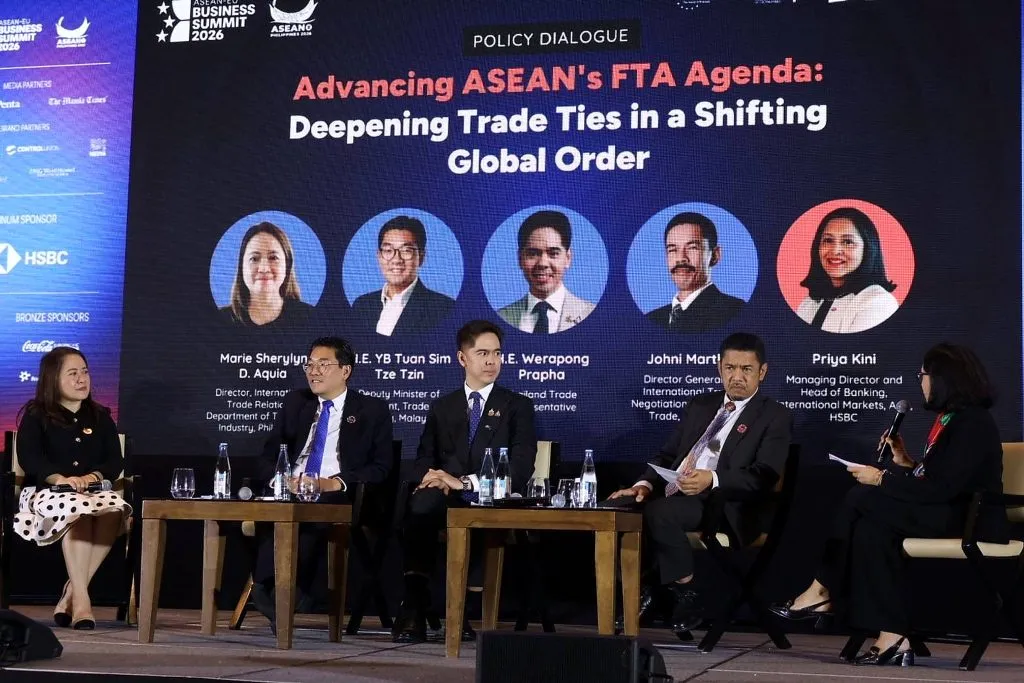
Thai Trade representatives participate in the policy dialogue during the ASEAN-EU Business Summit 2026 in Manila.
Source: ThaiGov / Website
Werapong said Thailand is seeking to become a reliable European partner through three priorities:
- Aligning with EU standards on sustainability, labour and responsible business
- Advancing the Thailand-EU FTA to reduce trade barriers and align regulations
- Reforming the domestic economy to make it easier to invest and operate
The negotiations have already covered 15 of 24 chapters, with the 10th round being held in Thailand and negotiators targeting a conclusion by the end of 2026.
The agreement is significant because it serves as a mechanism for improving rules and covering areas from investment, intellectual property, and government procurement to energy, agriculture, and digital trade, while also encouraging the nation to move further into higher-value supply chains.
That pressure comes as Southeast Asia competes aggressively for investment amid efforts by companies to diversify manufacturing beyond China. Vietnam and Malaysia already have EU trade agreements, increasing the importance for Thailand to improve its own market access and investment environment.
Competing for the next investment wave
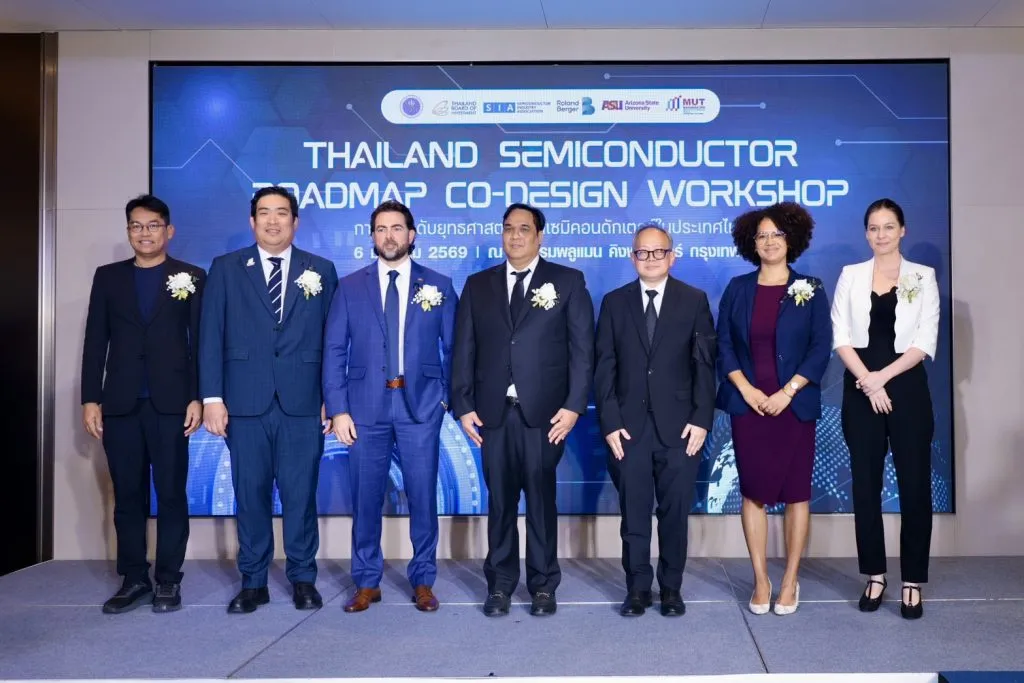
Officials and industry partners attend the Thailand Semiconductor Roadmap Co-Design Workshop at Pullman Bangkok King Power.
Source: ThaiGov / Website
The EU-ASEAN Business Council said 78% of respondents in its latest survey expect trade and investment in ASEAN to increase over the next five years, while 67% of companies considering supply-chain shifts identified ASEAN as a destination.
Thailand is seeking to capture part of that investment through sectors including semiconductors, clean energy, healthcare, AI, and future foods.
European investors have nevertheless identified areas such as regulatory complexity, transparency, and intellectual property protection in need of improvement. The Thai government has responded with its “Regulatory Guillotine,” aimed at modernizing over 7,000 laws and regulations, alongside infrastructure and workforce initiatives.
The Thai business community has also acknowledged that reforms still have a long way to go.
“Assessing our structural reform progress today, we sit at roughly a five-out-of-ten,” said Payong Srivanich, Chairman of the Joint Standing Committee on Commerce, Industry and Banking (JSCCIB). “We must urgently shift commercial banking liquidity away from stagnant legacy sectors and into future growth engines.”
Thailand is also pursuing OECD membership, which the government views as another route towards internationally recognized standards and greater investor confidence.
A European push with ASEAN ambitions
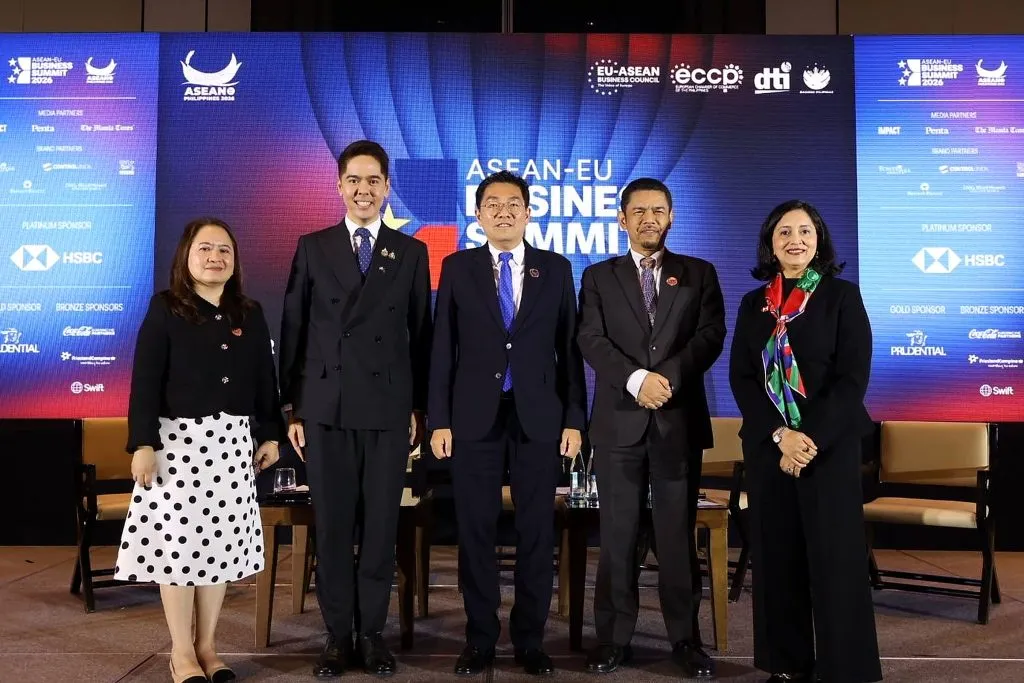
Thai Trade Representative Werapong Prapha joins fellow policy dialogue participants at the ASEAN-EU Business Summit 2026 in Manila.
Source: ThaiGov / Website
In addition to securing preferential access to the European market, Werapong’s emphasis on “co-creation” and “shared prosperity” is consistent with Thailand’s aim to connect its small and medium-sized enterprises (SMEs) and farmers to European and global value chains.
The approach also aligns with the wider ASEAN agenda discussed at the summit, from energy transition and digital connectivity to financial inclusion and human capital.
With Thailand preparing to assume the ASEAN chairmanship in 2028, the EU relationship is increasingly being framed as part of the Kingdom’s efforts to strengthen its position within a more integrated and competitive Southeast Asian economy.

 Teerin Julsawad