

Prime Minister Anutin Charnvirakul has used Thailand’s first leader-level visit to Australia in 14 years to lay out how the Kingdom intends to navigate an increasingly precarious international environment. The familiar message was that Thailand isn’t looking to choose sides, but nevertheless wants to have options.
The trip, made at the invitation of Australian Prime Minister Anthony Albanese, produced a series of agreements covering security, trade, and science. It also comes ahead of the 75th anniversary of diplomatic relations in 2027.
Key Takeaways
- Prime Minister Anutin Charnvirakul made Thailand’s first leader-level visit to Australia in 14 years at the invitation of PM Anthony Albanese.
- Anutin framed Thailand’s foreign policy as “strategic autonomy,” meaning independent decision-making based on national interests rather than neutrality on every issue.
- Thailand and Australia signed a joint statement on transnational crime covering online scams, cybercrime, human and drug trafficking, and asset recovery.
- Bilateral trade reached nearly US$23 billion in 2025, with TAFTA in force since 2005 and Canva aiming to grow Thai Canva Creators from about 190 to 1,000 by 2028.
- The visit sets the stage for Albanese’s reciprocal trip to Thailand next year and the 75th anniversary of diplomatic relations in 2027.
Keeping Thailand’s room to maneuver
Source: Thaigov.go.th / Website
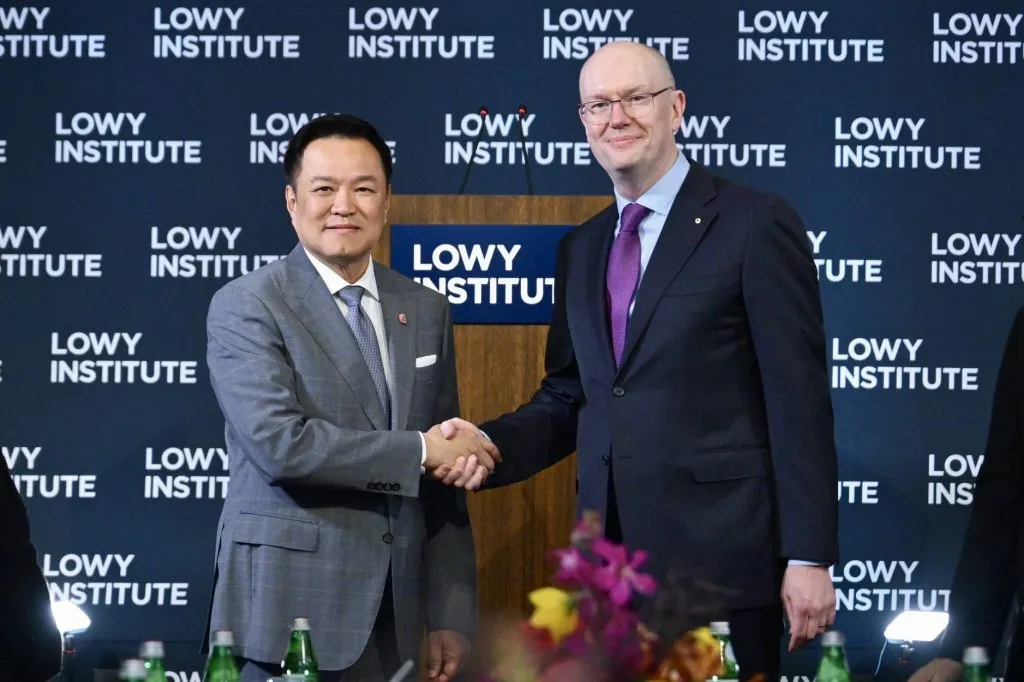
Speaking at the Lowy Institute in Sydney, the Thai premier described Thailand’s approach as “strategic autonomy”.
That doesn’t mean remaining neutral on every issue, he said, but it does mean maintaining the ability to make independent decisions, working with a diverse range of partners, and judging each issue according to national interests.
“For Thailand and Australia, this is particularly important because we both benefit from an international environment that is open, stable, and predictable,” Anutin said, adding that the two countries may not determine the global balance of power, but they can still help determine how that power is used in the region.
His answer was therefore to strengthen ASEAN and other regional mechanisms, while also diversifying partnerships and building economic resilience without retreating from an open global economy.
Fortifying a resilient Thai-Australian partnership
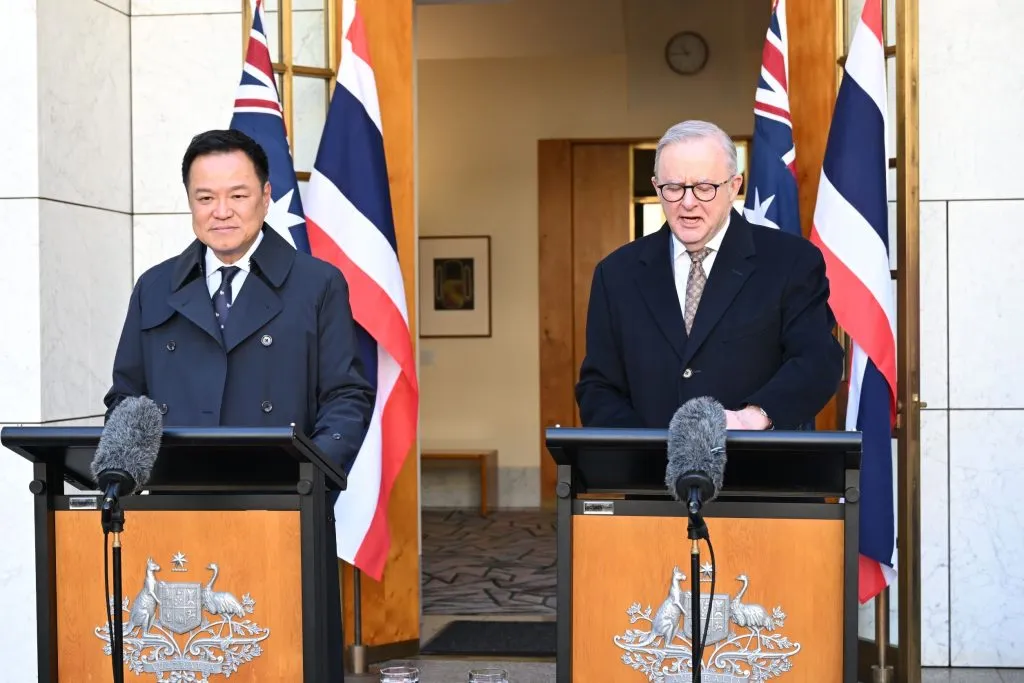
Left: Thai Prime Minister Anutin Charnvirakul. Right: Australian Prime Minister Anthony Albanese. Source: Thaigov.go.th / Website
Thailand and Australia signed a joint statement on transnational crime covering areas such as online scams, cybercrime, and human and drug trafficking. The two sides agreed to deepen cooperation between various agencies, including efforts to trace and recover criminal proceeds.
At the same time, Anutin made clear that economic security would be just as important to the relationship. Bilateral trade reached nearly US$23 billion in 2025, while the Thailand-Australia Free Trade Agreement (TAFTA) has been in force since 2005. The next step, he argued, is to turn those foundations into a “resilient partnership.”
That ambition was reflected in the large Thai business delegation accompanying the prime minister, as he urged Australian companies to invest in Thailand and view it as a gateway into the ASEAN market of nearly 700 million people.
Technology takes Thai creativity global

Source: Thaigov.go.th / Website
At Canva, technology was another part of Anutin’s pitch as he discussed expanding opportunities for Thai creators to reach global markets, with the company aiming to increase the number of Thai Canva Creators from around 190 currently to 1,000 by 2028.
“Thai people today are no longer coming simply to sell cheap labor,” he said. “The success of young Thais working at global technology companies such as Canva demonstrates how talent and intellectual capacity can drive leading organizations to outstanding levels of performance.”
The overarching aim of the visit was, therefore, notably broader than stronger bilateral ties, as Thailand seeks strategic partnerships to help drive investment, innovation, skills, and job creation.
With Albanese due to visit Thailand next year, the 75th anniversary provides both governments a chance to turn decades of diplomatic ties into something far more consequential for the decades ahead.

 Teerin Julsawad
  Thailand NOW