

Thailand and Switzerland are stepping up efforts to deepen trade and investment ties ahead of a planned January 2027 free trade agreement, with Bangkok seeking to turn stronger economic relations into technology transfers, industrial investment, and new opportunities for local businesses.
The push gathered momentum during Swiss President Guy Parmelin’s official visit to Thailand last week, which coincided with the 2026 International Monetary Fund and World Bank Group Annual Meetings in Bangkok. The visit also marked 95 years of diplomatic relations and was the first official visit by a Swiss president to Thailand in over two decades.
Key Takeaways
- Thailand and Switzerland are finalizing domestic procedures to implement the parliament-approved Thailand-EFTA Free Trade Agreement with Switzerland, Norway, Iceland, and Liechtenstein in January 2027.
- Prime Minister Anutin Charnvirakul and Swiss President Guy Parmelin met during the October 2026 IMF and World Bank Annual Meetings in Bangkok to prioritize advanced manufacturing, medical technology, and food innovation.
- Deputy Prime Minister and Commerce Minister Suphajee Suthumpun met with Swiss State Secretary Helene Budliger Artieda on October 16, 2026, alongside executives from Nestlé, Kühne+Nagel, Novartis, Roche, and Oerlikon exploring Thai expansion.
- The KliK Foundation plans to buy approximately US$120 million in carbon credits from Thai climate projects under Article 6 of the Paris Agreement, building on Bangkok’s 2,000-bus electric transit program.
- Prime Minister Anutin Charnvirakul and Liechtenstein Prime Minister Brigitte Haas also met on October 16, 2026, to advance financial cooperation and a double taxation agreement alongside the trade pact.
Thai supply chains meet Swiss investment
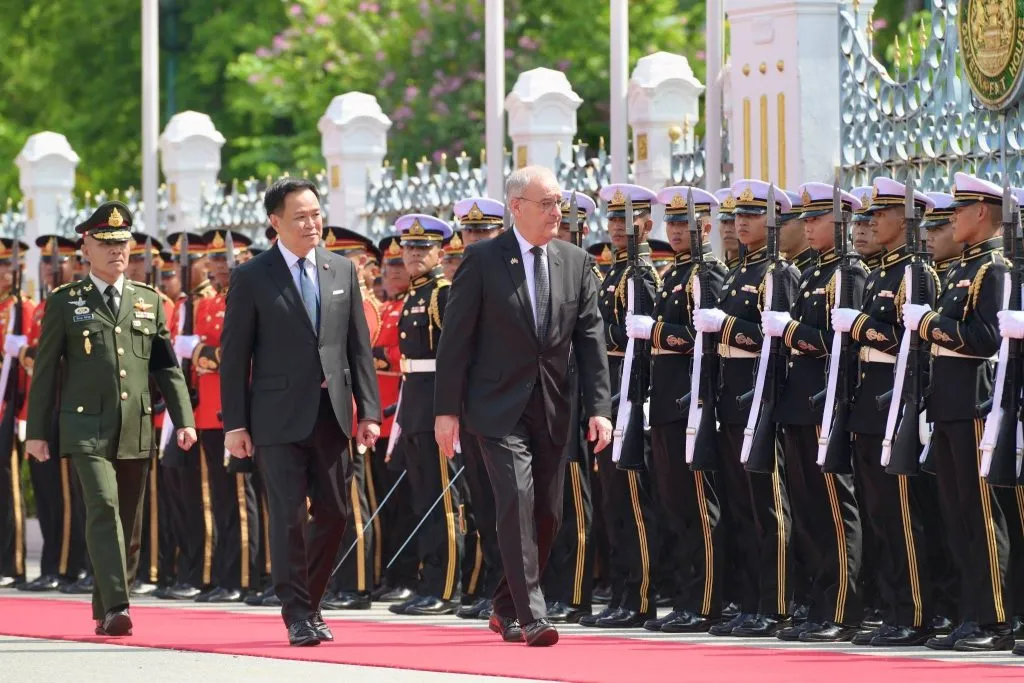
Thai Prime Minister Anutin Charnvirakul and Swiss President Guy Parmelin walk along a red carpet past a row of guards of honor.
Source: ThaiGov.go.th
Thai Prime Minister Anutin Charnvirakul and Parmelin reaffirmed their commitment to accelerating preparations for the Thailand-EFTA Free Trade Agreement, which has received parliamentary approval, while identifying areas such as advanced manufacturing, medical technology, and food innovation as priority areas for cooperation.
“Discussions had been constructive, with both sides reaffirming their commitment to strengthening their longstanding friendship and advancing practical cooperation for the mutual benefit of their peoples,” Anutin said.
The deal, which involves Switzerland, Norway, Iceland, and Liechtenstein, is expected to widen market access and strengthen commercial ties. Additionally, Thai officials emphasized tech transfers and workforce development, as well as integration of Thai small and medium-sized enterprises (SMEs) into global supply chains.
Those priorities were reinforced on October 16th, when Deputy Prime Minister and Commerce Minister Suphajee Suthumpun met with Swiss State Secretary for Economic Affairs Helene Budliger Artieda and executives from major Swiss companies.
- Nestlé plans further investment in Thailand, including a new coffee factory and expansion of its pet food business.
- Logistics group Kühne+Nagel sees opportunities in warehousing and supply chains serving cloud computing and data centers.
- Pharmaceutical companies Novartis and Roche could expand cooperation in medical research.
- Advanced materials specialist Oerlikon is exploring investments supporting Thailand’s aviation and semiconductor industries.
Suphajee stressed that the deal’s success would depend on whether businesses could substantially benefit from its provisions. Thailand is seeking to help domestic firms meet international standards and connect with multinationals, while attracting investment in advanced technologies and renewable energy.
Climate cooperation adds a green dimension
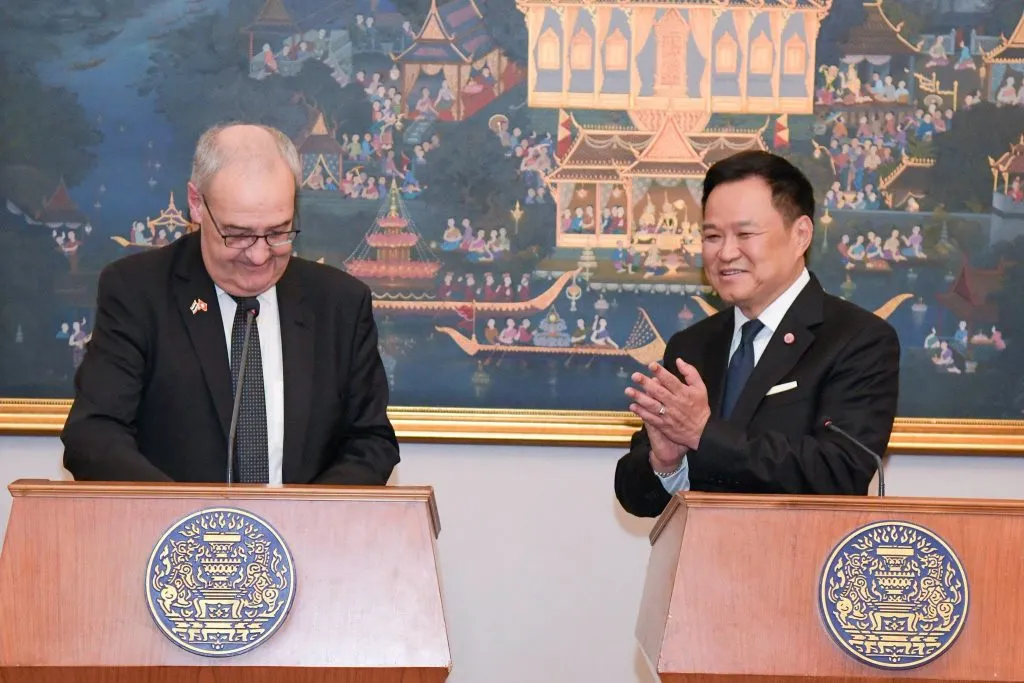
Thai Prime Minister Anutin Charnvirakul and Swiss President Guy Parmelin stand behind official wooden lecterns.
Source: ThaigovSpokesman
The economic agenda also encompasses climate action, research, and skills development. Thailand and Switzerland have cooperated under Article 6 of the Paris Agreement, including through Bangkok’s electric bus program, which has introduced approximately 2,000 buses into service.
The KliK Foundation is expected to purchase around US$120 million in carbon credits from new Thai climate projects, potentially unlocking additional financing for emissions reductions.
Thailand and Liechtenstein are pursuing complementary opportunities. During talks between Anutin and Liechtenstein Prime Minister Brigitte Haas on October 16th, both sides discussed the Thailand-EFTA agreement, financial cooperation, and a potential double taxation agreement.
Thailand-Switzerland bilateral trade reached US$14.24 billion in 2025, up 31.12% year-on-year. Trade totaled US$9.56 billion in the first eight months of 2026, an increase of 26%.
The two countries are finalizing domestic procedures ahead of the agreement’s targeted implementation. Their immediate challenge is converting that momentum into a framework that delivers wider market access and stronger industrial capabilities to secure sustainable growth for both sides.

 Teerin Julsawad
 Thailand NOW