

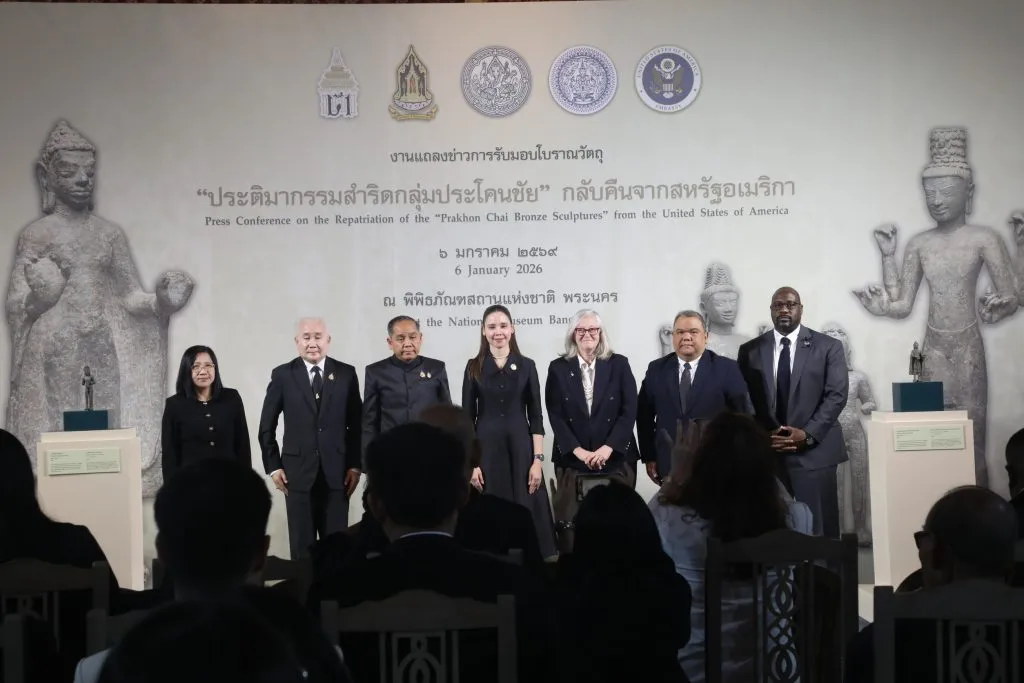
Four ancient bronze sculptures have returned to Thailand after more than half a century abroad. The official handover ceremony took place at the Isravinitchai Throne Hall inside the National Museum Bangkok, presided over by Culture Minister Sabeeda Thaised and attended by representatives from Thailand’s Ministry of Culture, Ministry of Foreign Affairs, the Fine Arts Department, the Royal Thai Consulate–General in Los Angeles, and the United States government.
The sculptures, known collectively as the Prakhon Chai Bronze Sculpture Group, were repatriated from the Asian Art Museum of San Francisco following years of coordination between Thai authorities and U.S. agencies, including Homeland Security Investigations (HSI). Their return marks a significant moment in Thailand’s ongoing efforts to recover cultural heritage that left the country through illegal excavation and trafficking in the mid-20th century.
Origins of the Prakhon Chai Bronze Sculptures
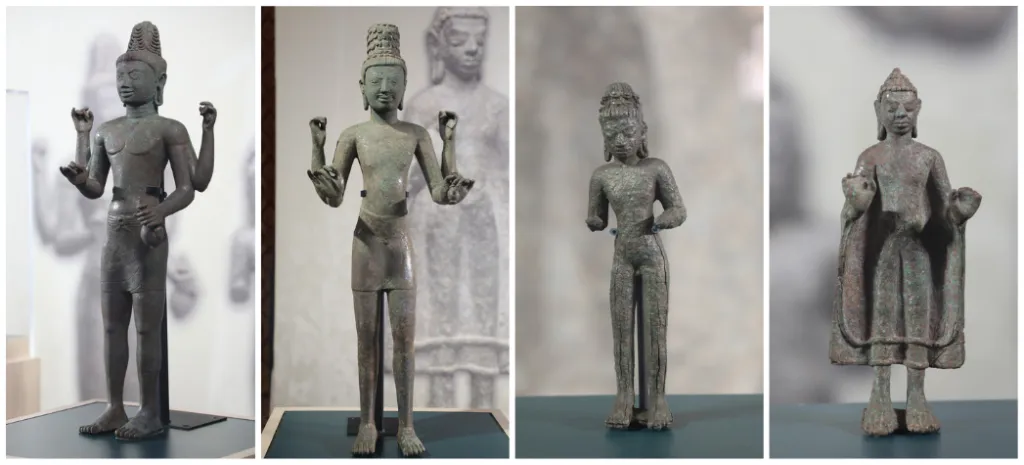
The four works consist of three Bodhisattva figures and one Buddha image, all cast in bronze and dated to the 8th or 9th century, making them approximately 1,200 years old. According to Thai authorities and archaeologists cited in Thai media, the sculptures were originally taken from Prasat Khao Plai Bat II, an ancient site in the Prakhon Chai district of Buriram province.
This region sits within Thailand’s lower northeastern zone, an area that archaeological research increasingly recognizes as culturally and technologically sophisticated during the early Buddhist period. The Prakhon Chai bronzes are linked to the ancient polity of Sri Canasapura, associated with the Dvaravati cultural sphere that once flourished across parts of present-day Thailand.
Their craftsmanship reflects advanced bronze-casting techniques and deep Buddhist devotion, challenging older historical narratives that portrayed the Isan region as sparsely populated or culturally peripheral during this era.
Illegal excavation, illicit trafficking, and ultimate repatriation
The circumstances under which the sculptures left Thailand trace back to a documented looting operation in 1964, when artifacts from the Prakhon Chai area were illegally excavated and sold to international dealers. Investigations later identified the late Douglas Latchford as a key figure involved in smuggling Thai antiquities out of the country.
From there, the bronzes circulated through Western collections before ultimately entering the holdings of the Asian Art Museum of San Francisco.
In recent years, Thai authorities intensified efforts to trace and recover antiquities connected to this trafficking network. The return of the Prakhon Chai bronzes followed sustained cooperation among Thailand’s Committee for the Repatriation of Overseas Antiquities, the Fine Arts Department, the Ministry of Foreign Affairs, and U.S. counterparts.
According to official statements, the Asian Art Museum permanently deaccessioned all four sculptures in 2025, allowing the repatriation process to proceed through diplomatic and legal channels rather than litigation.
Thailand’s evolving approach to cultural repatriation
Officials have emphasized that the return of these objects is not merely symbolic. The bronzes are considered critical archaeological evidence, offering insight into religious practice, metallurgy, and regional power structures along the Mun River basin and the broader Khorat Plateau more than a millennium ago. Studied alongside related architectural remains and artifacts, they help fill gaps in Thailand’s historical record, particularly for the Northeast.
Now housed at the National Museum Bangkok, the sculptures will undergo detailed conservation and scholarly study before being made accessible to the public. Thai authorities note that displaying the works in Thailand allows them to be understood within their original cultural and historical context, rather than as isolated art objects detached from place.
The repatriation of the Prakhon Chai bronzes also reflects a broader shift in how cultural heritage recovery is handled. Thai agencies describe the process as collaborative rather than confrontational, relying on long-term research, documentation, and cooperation with foreign institutions and law enforcement. It is part of an ongoing national commitment to identifying and returning antiquities that were removed from Thailand unlawfully.
What this means for Isan and Thailand’s historical continuity

For regions like Buriram and the wider Northeast, the return carries added weight. These sculptures reconnect local communities to tangible evidence of their ancient past, reinforcing the role of the region in Thailand’s early Buddhist and artistic history.
The return of the Prakhon Chai bronzes also reflects how cultural heritage recovery is now handled. In cases like this, repatriation is less about reversing history than about clarifying responsibility going forward. Museums are reassessing collections, governments are investing in research, and international cooperation is becoming procedural rather than exceptional.
None of this erases the decades these objects spent abroad, of course. But it does change what happens next.
Back in Thailand, the sculptures now function as evidence, reference points, and teaching tools. They reconnect craftsmanship to place, belief to landscape, and history to living memory. Their return is restoring continuity to a story that was interrupted, and allowing it to be studied and understood where it began (on Thai soil).
That, ultimately, is what repatriation makes possible.

 Thailand NOW